
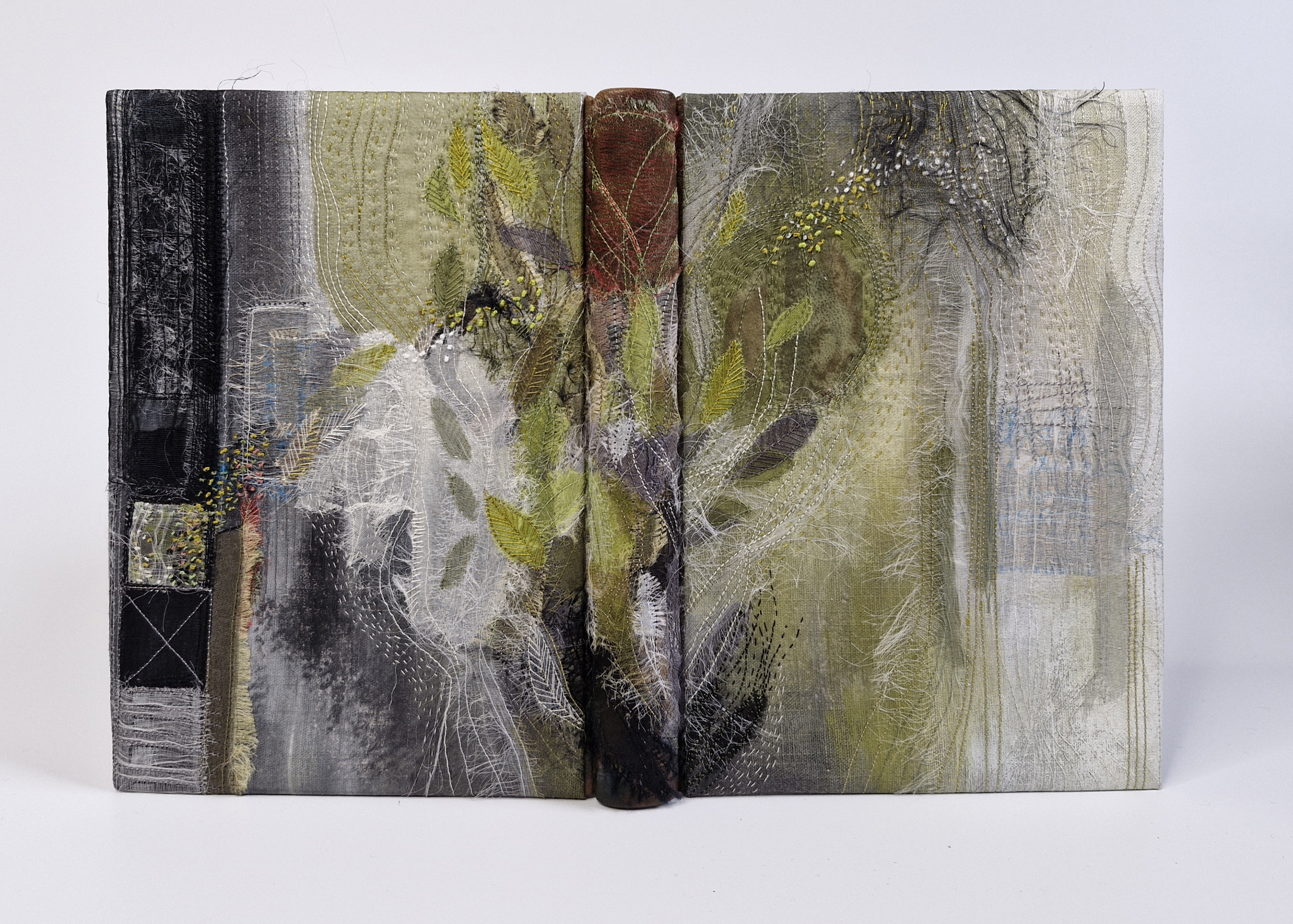
Vladimir Nabokov, Mary, tr. Michael Glenny (Weidenfeld and Nicolson, 1970). Bound by Sue Doggett, 2026.
Bookbinder's Statement
Mary, originally titled Mashen'ka, is a short novel by Vladimir Nabokov written in 1926 under the pen name V.Sirin.
My creative responses to Mary are based primarily on the notions of time and memory embedded in a story about love, displacement, regret and longing. Lev Glebovich Ganin, a Russian émigré, has been displaced by the Russian revolution. He lives in a run-down boarding house in Berlin with a number of other Russian émigrés, including the poet Podtyagin, a young girl named Klara, two male ballet dancers, Kolin and Gornotsvetov, the landlady, Lydia Dorn, and Ganin’s neighbour Aleksey Ivanovich Alfyorov, whom he meets when stuck in the lift at the very start of the story.
Through a series of conversations with Alfyorov, it transpires that the man’s wife is Mary, Ganin’s first love. When Ganin discovers this, it is a pivotal moment in both the novel and his life. The photograph of Mary that Alfyorov shows Ganin, depicts her looking exactly as he remembers her. This event triggers a series of detailed, intimate and rich memories for Ganin that are in complete contrast to the flat, greyness of his depiction of his life in Berlin.
The idea of memory, what it is and what it does, is intricately wound around a love story of the imagination. We realise early on that Mary is created from Ganin’s teenage imagination, which is projected on to the form of the ‘real’ Mary. Although the real Mary is Ganin’s first love, over time, he comes to understand that this idealised love only really exists when the lovers are apart and it is expressed in their letters and their longing. When Ganin eventually realises this, he is able to move forward with his life.
Eric Laursen, in his article 'Memory in Nabokov’s Mary', cites Henri Bergson who
posits two forms of memory: habit and pure memory. In the course of the novel Ganin goes from habit to pure memory. But neither form changes him into a man of action, a man capable of leaving the stagnation of his Berlin pension. In the end, this problem is resolved by a merging of habit and pure memory, which results in the acquisition of Ganin’s 'fresh loving eye'.[i]
In Berlin, Ganin is performing the actions of his life from habit. This keeps him in the present and allows him to exist but only in going through the motions of life, through impulse. Ganin is living from one moment to the next, doing a series of unfulfilling jobs to pay his way. This includes working as a film extra alongside many other émigrés, which, as Laursen points out, significantly alludes to the fact that "others in the pension share Ganin’s penchant for dreaming and his inability to move forward" (Laursen, 57) – they are stuck between what their lives were before the revolution and where they are now. For the protagonist Ganin, his encounter with his own image on screen provokes "a shudder of horror" as he realizes that he is "watching something vaguely yet horribly familiar"—a textbook case of Freud’s uncanny. True memory "retains and ranges alongside of each other all our states in the order in which they occur, leaving to each fact its place and consequently marking its date, truly moving in the past and not, like the first, in an ever renewed present". [iii] This is where Ganin’s memories of Mary are situated, brought back to life with intensity but still, as a mental picture. Laursen suggests that,
Whereas her husband prepares a physical room for Mary’s arrival, Ganin prepares a mental one: 'He was a god, recreating a world that had perished. Gradually he resurrected that world, to please the girl whom he did not dare to place in it until it was absolutely complete.'
Ganin is able to recall in such detail, the memories of Mary, of Russia and his early life in the memories presented throughout the novel:
He would lean on his bicycle, looking across the fields at one of those forest fringes only found in Russia, remote, serrated, black, while above it the golden west was broken only by single only by single long lilac cloud from under which the rays spread out like a burning fan. And as he stared at the sky and listened to a cow mooing almost dreamily in a distant village, he tried to understand what it all meant – that sky, and the fields and the humming telegraph pole…..‘Mary’, Ganin repeated again, trying to put into those two syllables all the music that they had once held – the wind, the humming of telegraph poles, the happiness – together with another, secret sound which gave that word its very life. He lay on his back and listened to his past. [iv]
These memories are not something that has been integrated into his current life, they are stuck in time. It is only through the active process of remembering the course of their relationship fully, that he realises that the memories are not a plan for a future life. This realisation is demonstrated in the final pages where Ganin, beginning to see the world anew, is transformed into a man of action. There is a direct link between the intensity of the memories that Ganin relives throughout the novel, and the way in which he describes his surroundings as he walks out of the boarding house:
Everything seemed askew, metamorphosed as in a mirror. And just as the sun rose higher and the shadows dispersed to their usual places, so in that sober light the world of memories in which Ganin had dwelt became what is was in reality: the distant past…….And the fact that he kept noticing everything with a fresh, loving eye – the carts driving to market, the slender, half-unfolded leaves and the many-coloured posters which a man in an apron was sticking around a kiosk – this fact meant a secret turning point for him – an awakening.
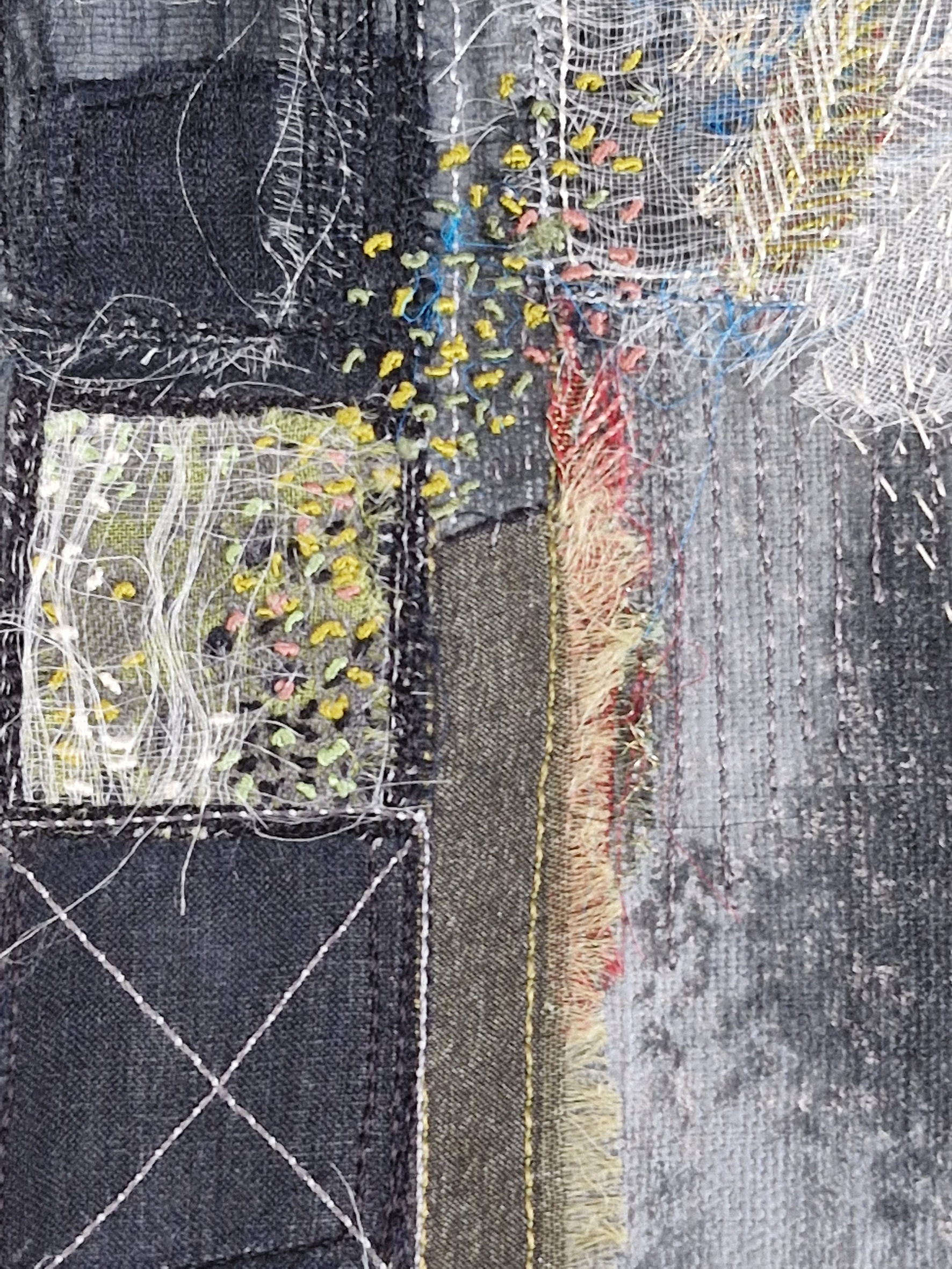
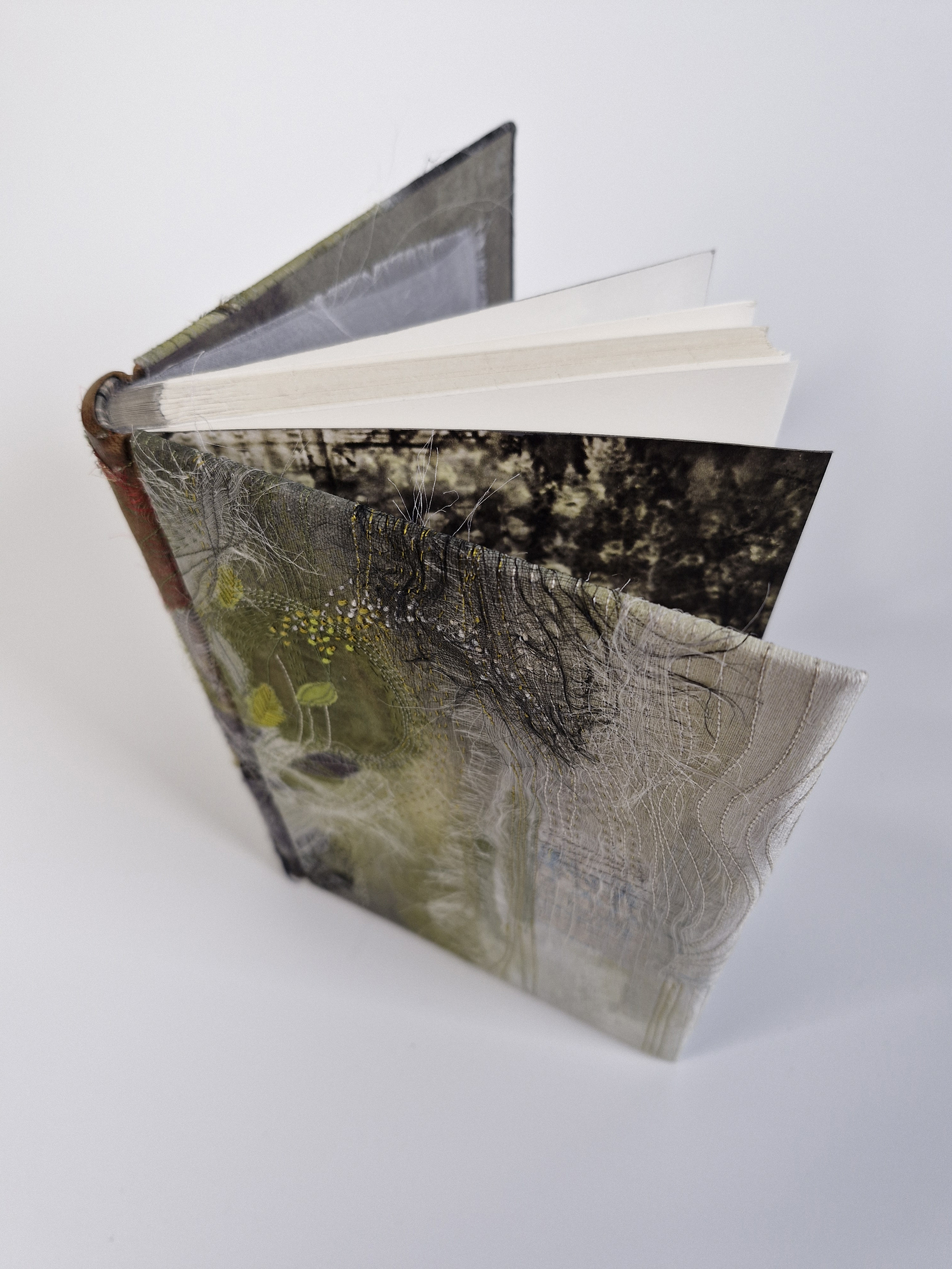
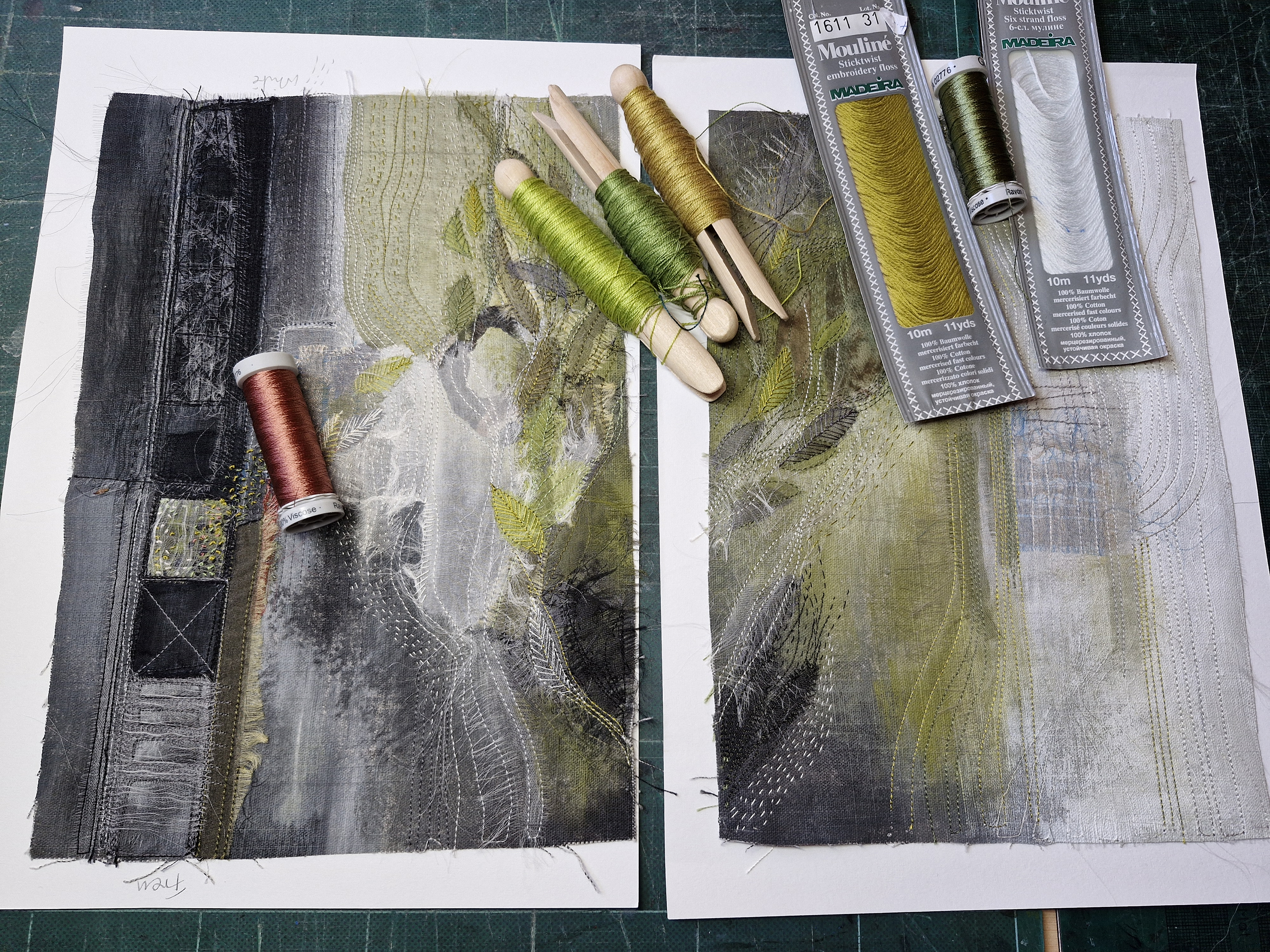
The form of Ganin’s remembering and the clear dividing events in the story, were the starting points for the binding. I chose to work the covers in fabric layers, which were dyed and painted to allow me a more fluid approach to constructing the design. I wanted to allude to the fact that Ganin is living in the present and the past, and the way in which the figure of Mary is remembered as she becomes alive for him and then returns to a memory. The use of different weights and colours of organza on a painted linen base, allowed me to experiment with this idea. The overall effect that I was aiming for was a shifting, shimmering haze. The design follows the arc of the story from the back to the front cover. It starts with the lift where Ganin meets Alfyorov, which is also a reference to the lighting rigs used in a theatre or on a film set. The arc moves from the lift to the photograph in which Ganin sees Mary for the first time and then towards the full blown memory episodes where his relationship with Mary is brought back to life; the Russian landscape, the trees in the park, the boat journey down the river and the stained glass in the ruined pavilion. Finally, as Ganin is walking towards the station to meet Mary, and the world looks different to him, he sees a group of tilers at work on a new roof, their repetition of movement, slow and methodical:
This lazy, regular process had a curiously calming effect; the yellow sheen of fresh timber was more alive than the most lifelike dream of the past. As Ganin looked up at the skeletal roof in the ethereal sky he realized with merciless clarity that his affair with Mary was ended forever. It had lasted no more than four days – four days which were perhaps the happiest days of his life. But now that he had exhausted his memories, was sated by them, and the image of Mary, together with that of the old dying poet, now remained in the house of ghosts, which itself was already a memory.
Other than that image no Mary existed, nor could exist. [v]
The arc of the design ends on the front cover with a hint at the roof which ‘shone like gold in the sun’. This storyline is echoed in a series of French knots, which appear in a dense configuration within the lift, float through the photograph, dispersing and reappearing until finally, disappearing above the building in construction on the front cover.
The end leaves are a digital collage of photographs and postcards of Berlin in the 1920s, German film sets and the Russian countryside at the turn of the nineteenth century. These compos
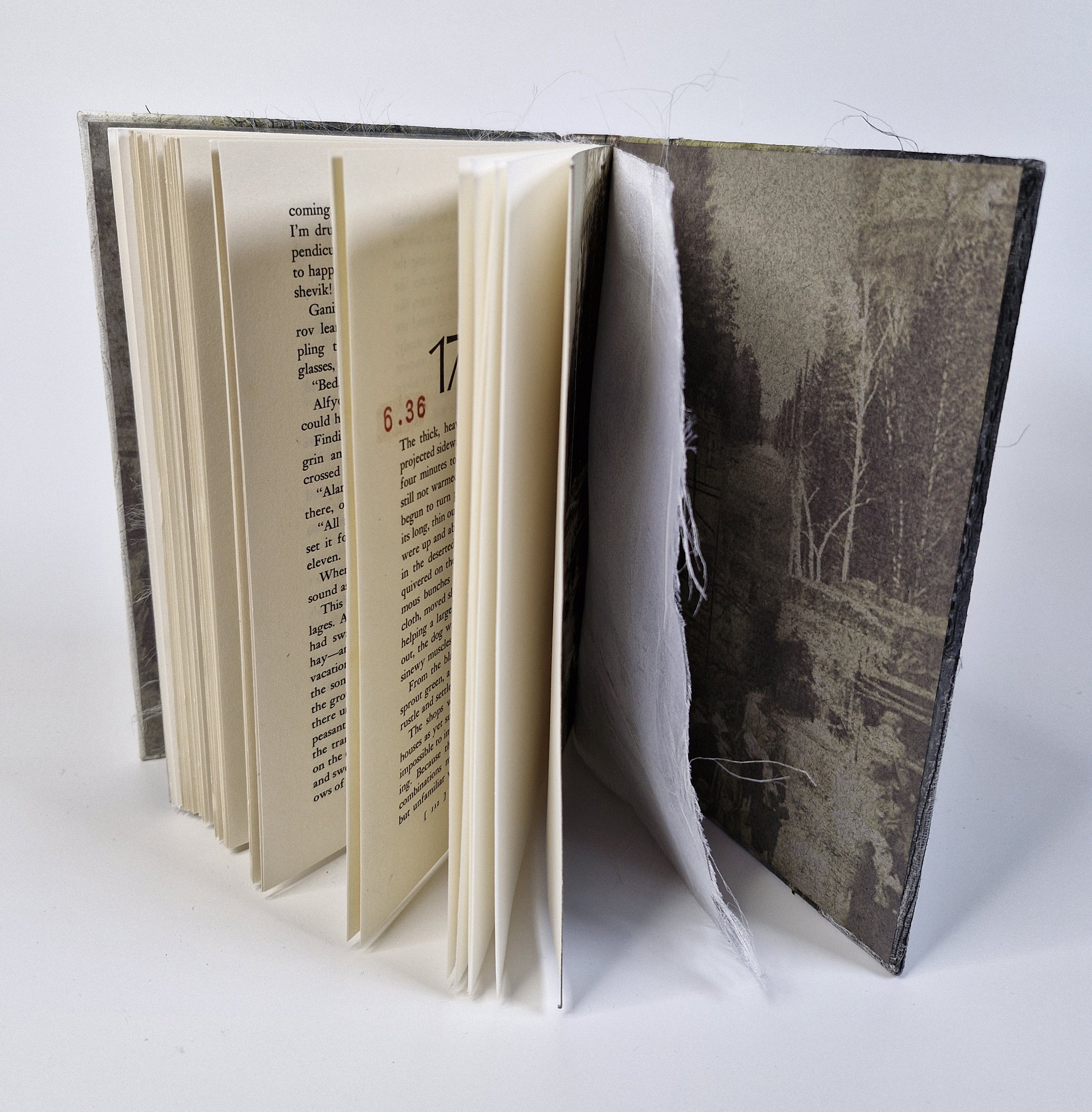
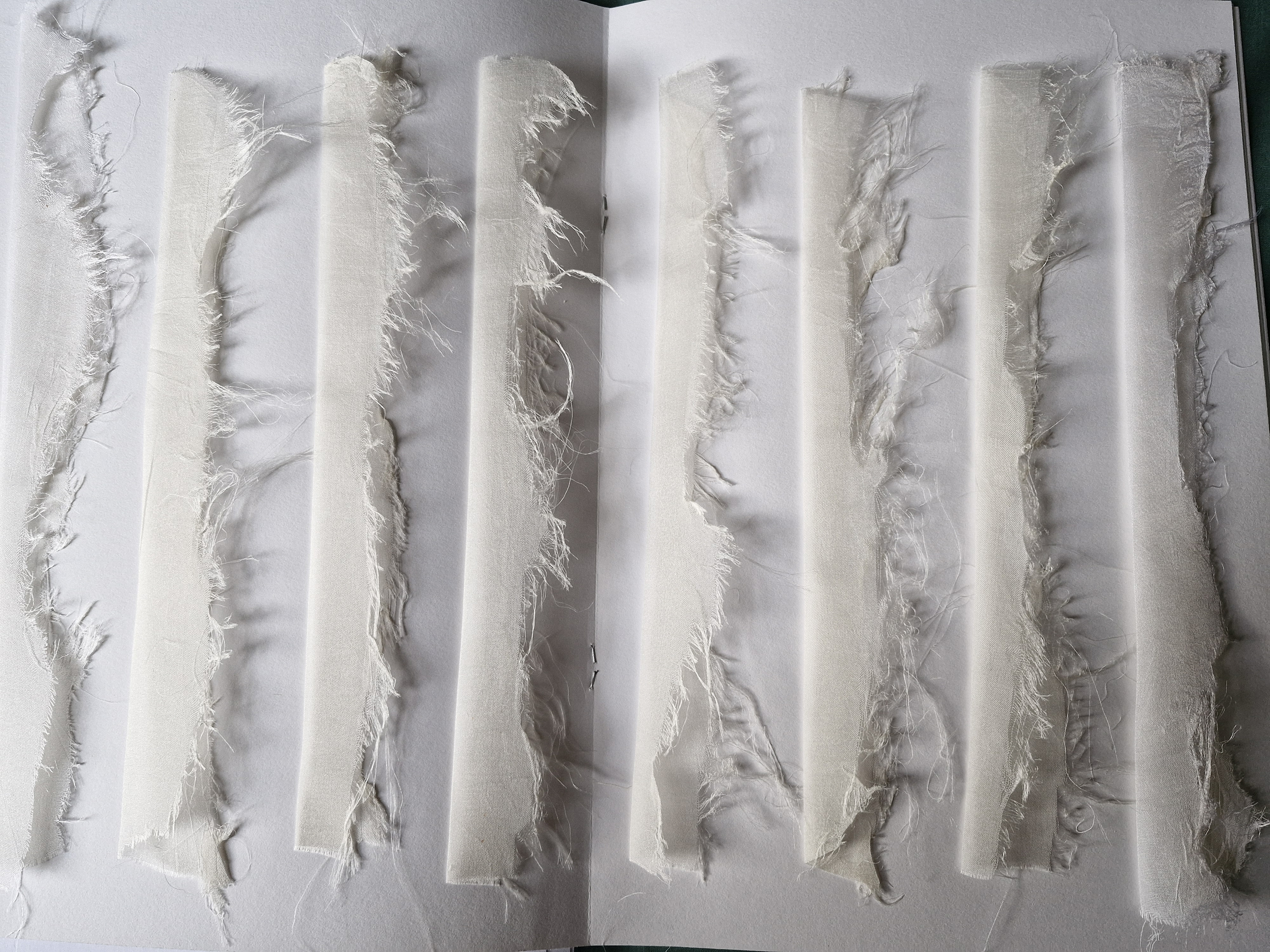
ite images are repeated in the stubs onto which the book is sewn. There are additional pieces of fabric between the sections and partially concealing the endleaves which also allude to Ganin’s interaction with his memories. I added another element to the book which referred to the relationship between time and memory in the form of date and time stamps at significant points on the pages of the book.
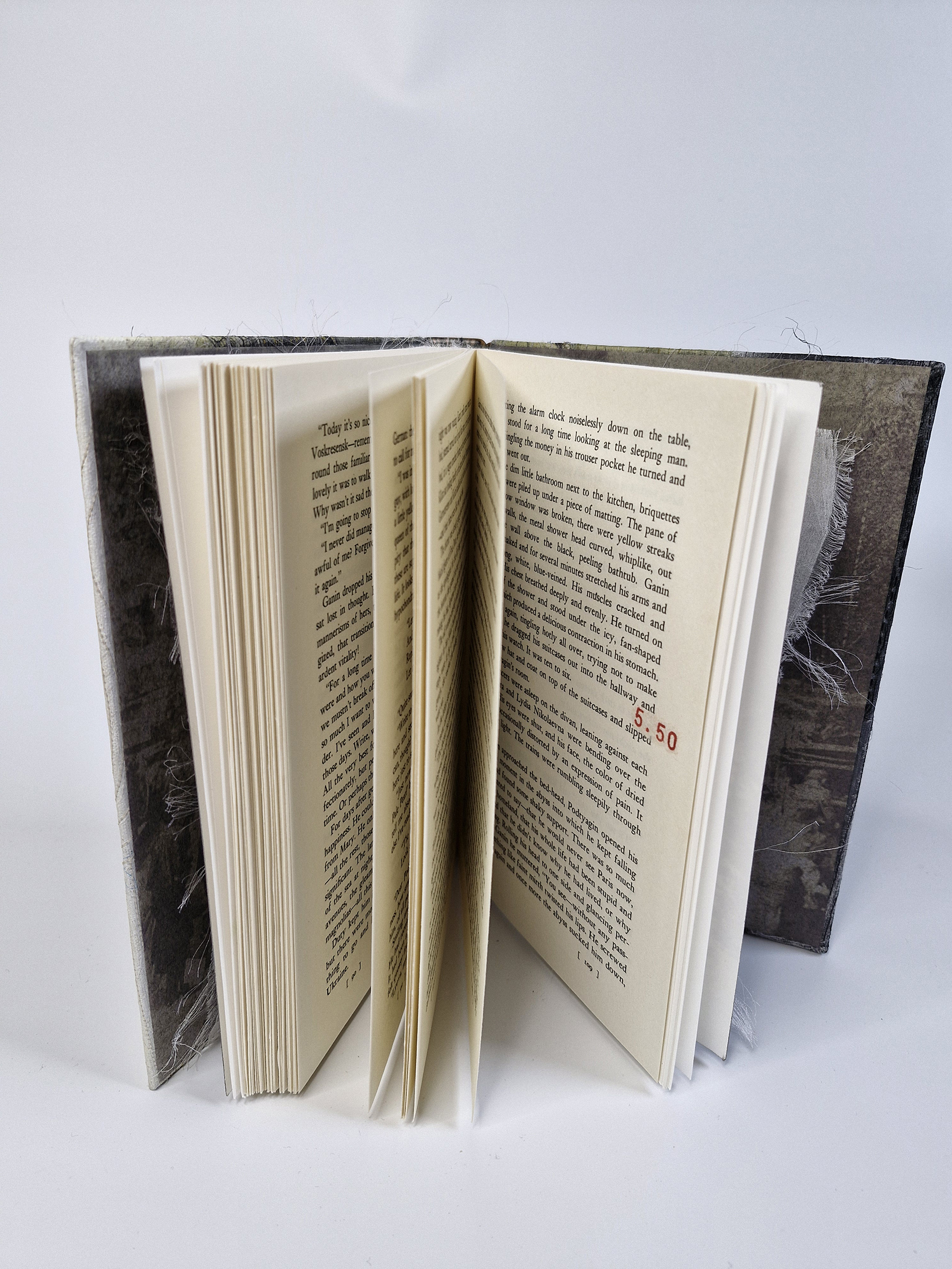
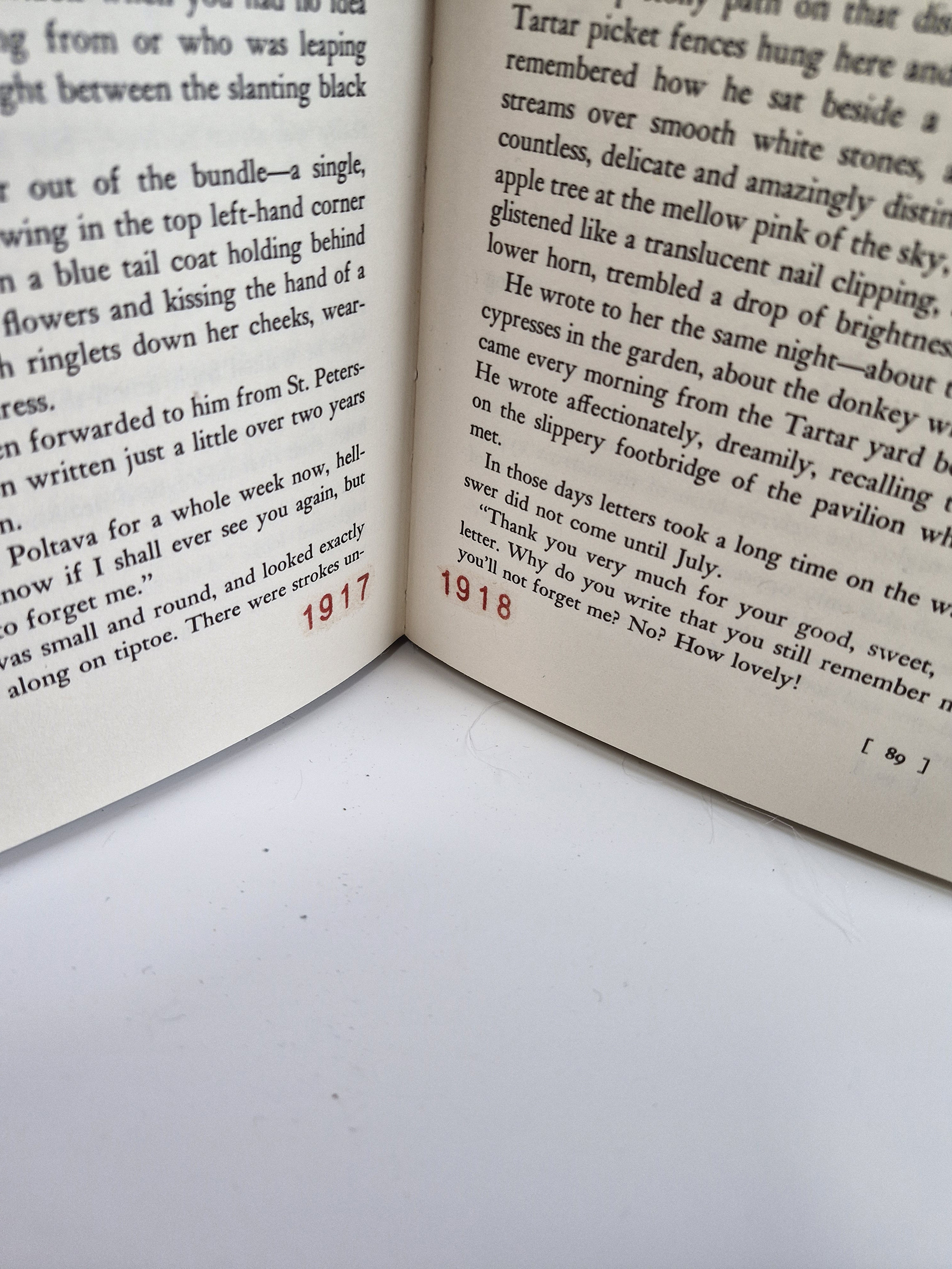
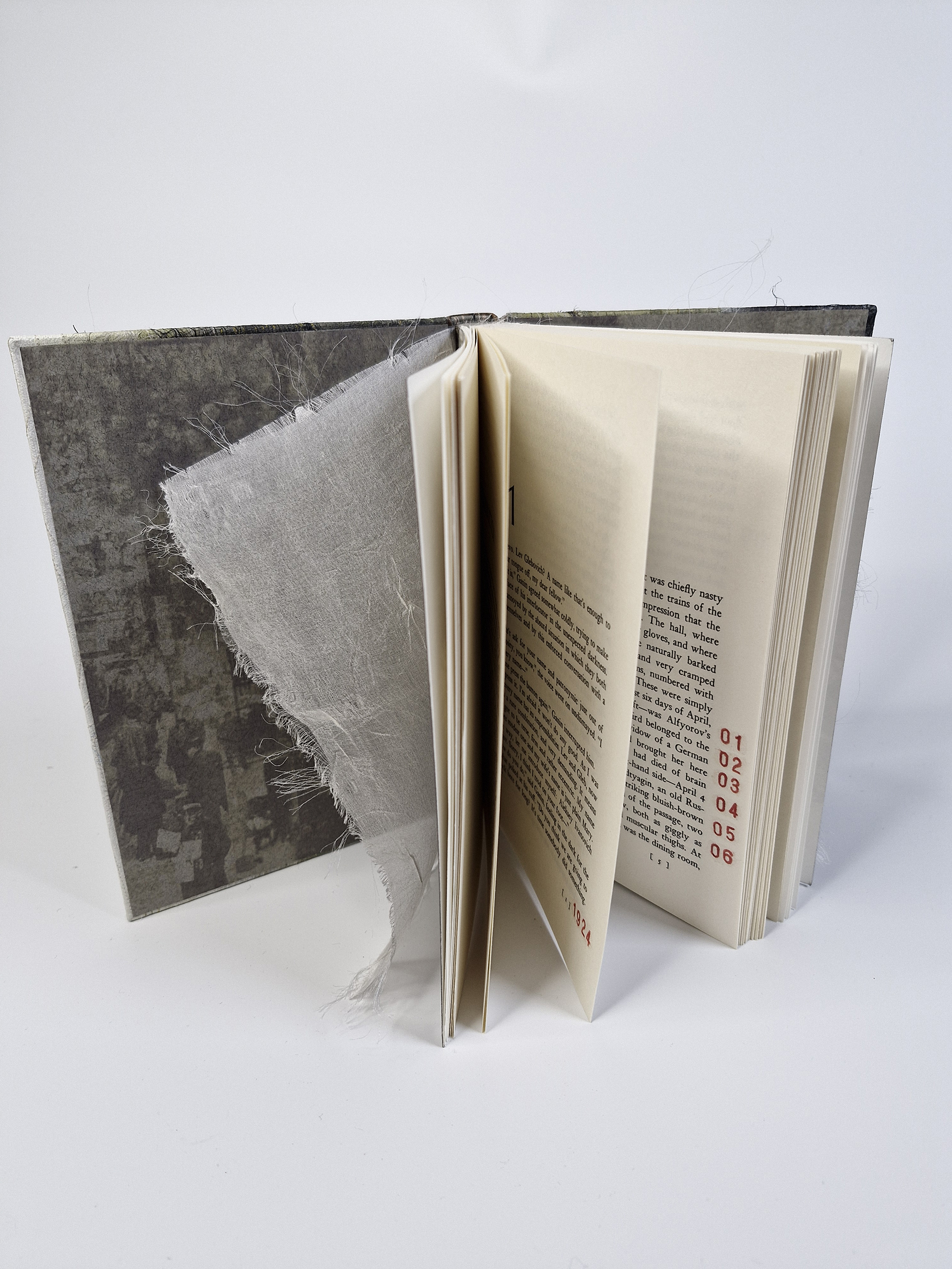
The dates are important as they set the narrative in a particular time and place (echoing Nabokov’s own experience). I used significant years that Ganin mentions which underlines the distance between his memories and his current life in Berlin in 1924. Towards the end of the

novel, the times become more urgent as Ganin prepares himself to leave the boarding house and time ticks towards 8am, which is the time of Mary’s arrival. The final set of dates are those which the landlady, Frau Dorn, has taken from her deceased husband’s desk calendar to use as room numbers. We have to assume he passed away in March 1923 as the dates used start at April 1st 1923, when the pages stopped being torn off.
One final detail is in the endbands on the head and tail of the book, where one single black thread references the large, black bow that Mary wore and how Ganin first sees her on the night of the concert staged in a barn somewhere on his parents’ estate:
Ganin saw only one thing: he stared ahead at a brown tress tied back with a black bow, slightly frayed at the edges, and his eyes caressed the dark, smooth girlish sheen of the hair of her temple…..And at that moment, when he sat on the window ledge of that lugubrious lavatory, and thought how he would probably never, never get to know the girl with the black bow on the nape of her delicate neck, and waited in vain for a nightingale to start trilling in the poplars as in a poem by Fet – that moment Ganin now rightly regarded as the highest, most important point in his whole life.
References
[I] Eric Laursen, 'Memory in Nabokov’s Mary', The Russian Review 55 (1996), p. 56.
[ii] Luke Parker, 'Nabokov’s Haunted Screen: The Exilic Uncanny in Weimar Film' , in Reimagining Nabokov: Pedagogies for the 21st Century, ed. Sara Karpukhin and José Vergara (Amherst College Press, 2022).
[iii] Henri Bergson, Matter and Memory, cited in Laursen, p. 57.
[iv] Vladimir Nabokov, Mary (Penguin, 2009), p. 48.
[v] Nabokov, Mary, p. 116.