
By Matt Davies
The Nabokov bookbinding project provided some funding to experiment with the creation of 3-D models of the design bindings. Matt Davies, Manager at the Digital Transformations Hub at the University of Nottingham, led on this part of the project. Below he explains more about the rather complex task of creating 3-D versions of the bookbindings.
The Digital Transformation Hub (DTH) is a resource centre that supports Faculty of Arts (FoA) staff and students at the University of Nottingham to use digital media in their teaching, research and learning. Digital imaging is a big part of what we do, and over the years we have provided FoA students with opportunities to learn archive, studio and green screen photography. Photogrammetry - which uses specialist software to combine multiple photographs of a single object to produce a digital 3D version - was a natural fit for us!
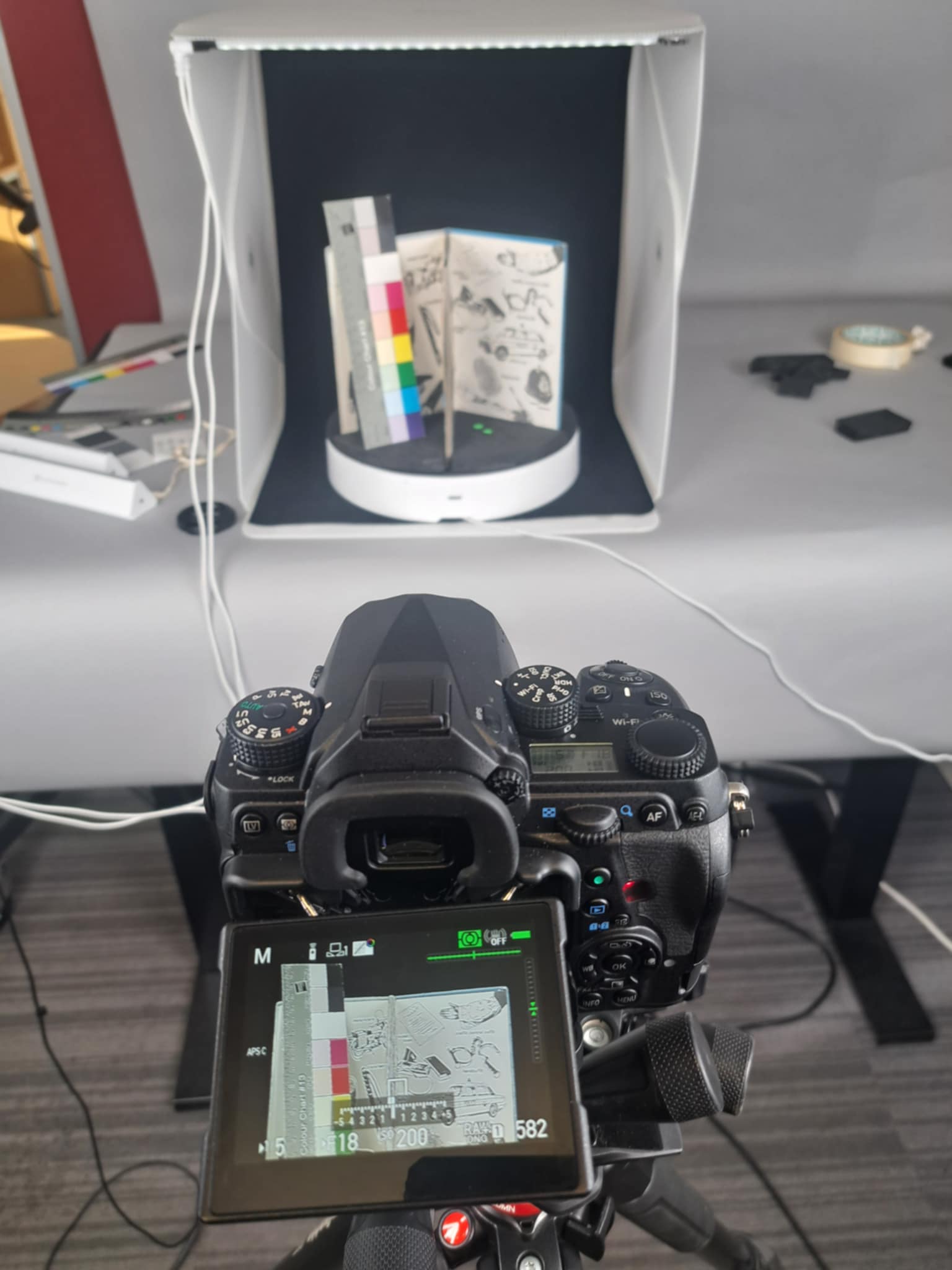
A general rule of photogrammetry is that the better the photos, the better the final model so instead of the usual method of walking around the object taking pictures, in the DTH we use turntable photography. In this method, the tripod mounted camera stays still and automatically shoots each time the object turns on a blue tooth synchronised turntable. This allows us to optimise the lighting and camera settings to get the best photographs possible.
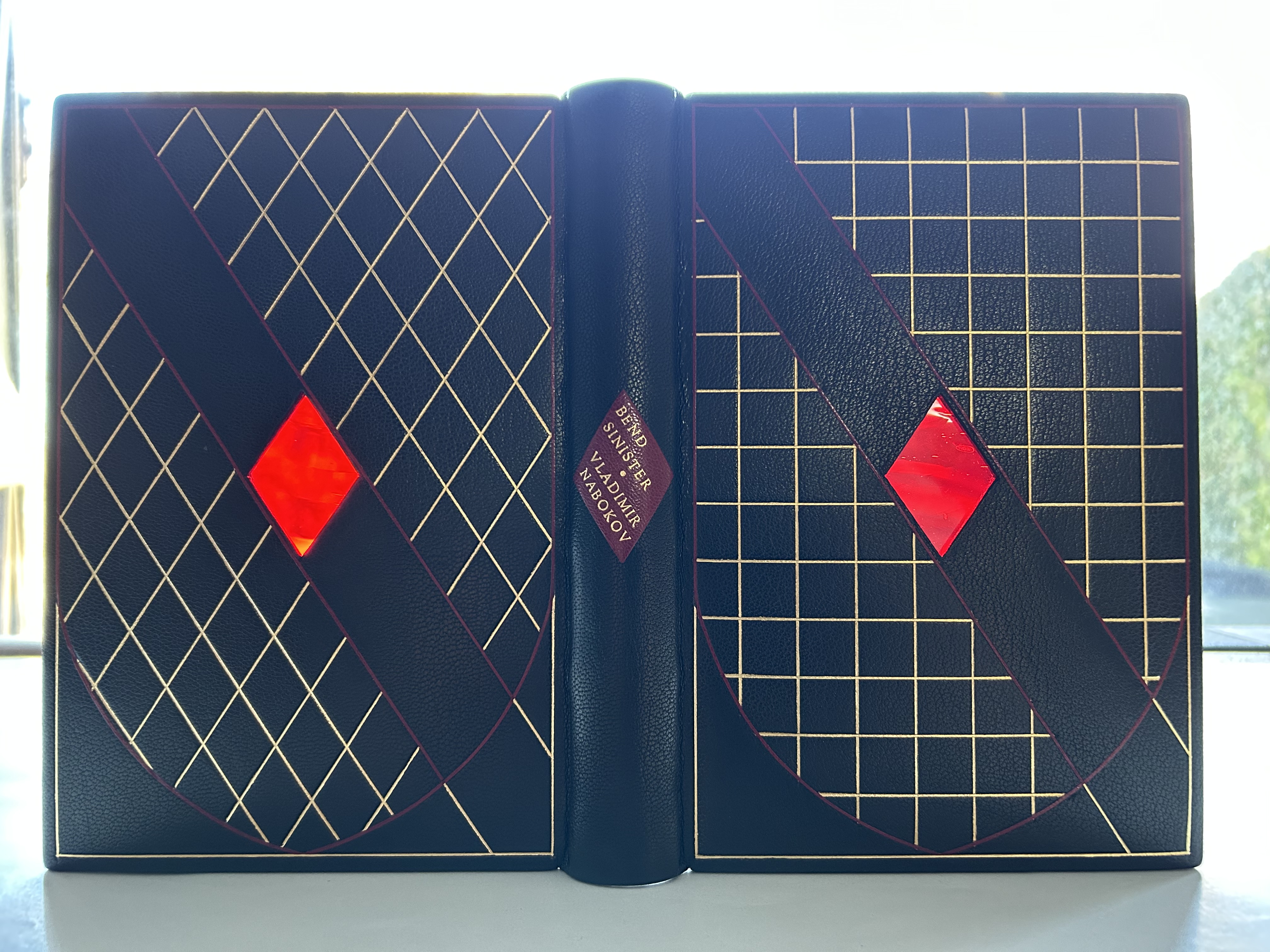
However, the 3D software does not like shiny, transparent or moving components which is where I hit some problems with the Nabokov books. Bend Sinister with its gold leaf inserts and red glass diamond shaped windows was a no-go unfortunately.
Also, it was decided that we wanted the books to stand open so that the viewer can see the designs on the endpapers inside as well as on the covers outside. This meant that pages not only fell open but also moved as the book turned. Reusable tape (so-called "magical tape"), which is non sticky and transparent, was the perfect solution holding the page block together.
Another issue was how to capture the bottom of the book without also including the turntable. The Classics and Archaeology department – just along the corridor from the DTH in the Humanities Building - recently invested in Artec laser scanners. The scanners work in an entirely different way, capturing objects in broad sweeps and are fantastic at surface area but not so good with texture as their cameras are very low resolution. However, my colleague, the Lab technician Susie Sherwood, had recently found a way to upload the texture generated from the DTH’s DSLR photos to the Artec software and apply it to the mesh produced from the scans and this is the method we used for Nabokov's novel Pnin.
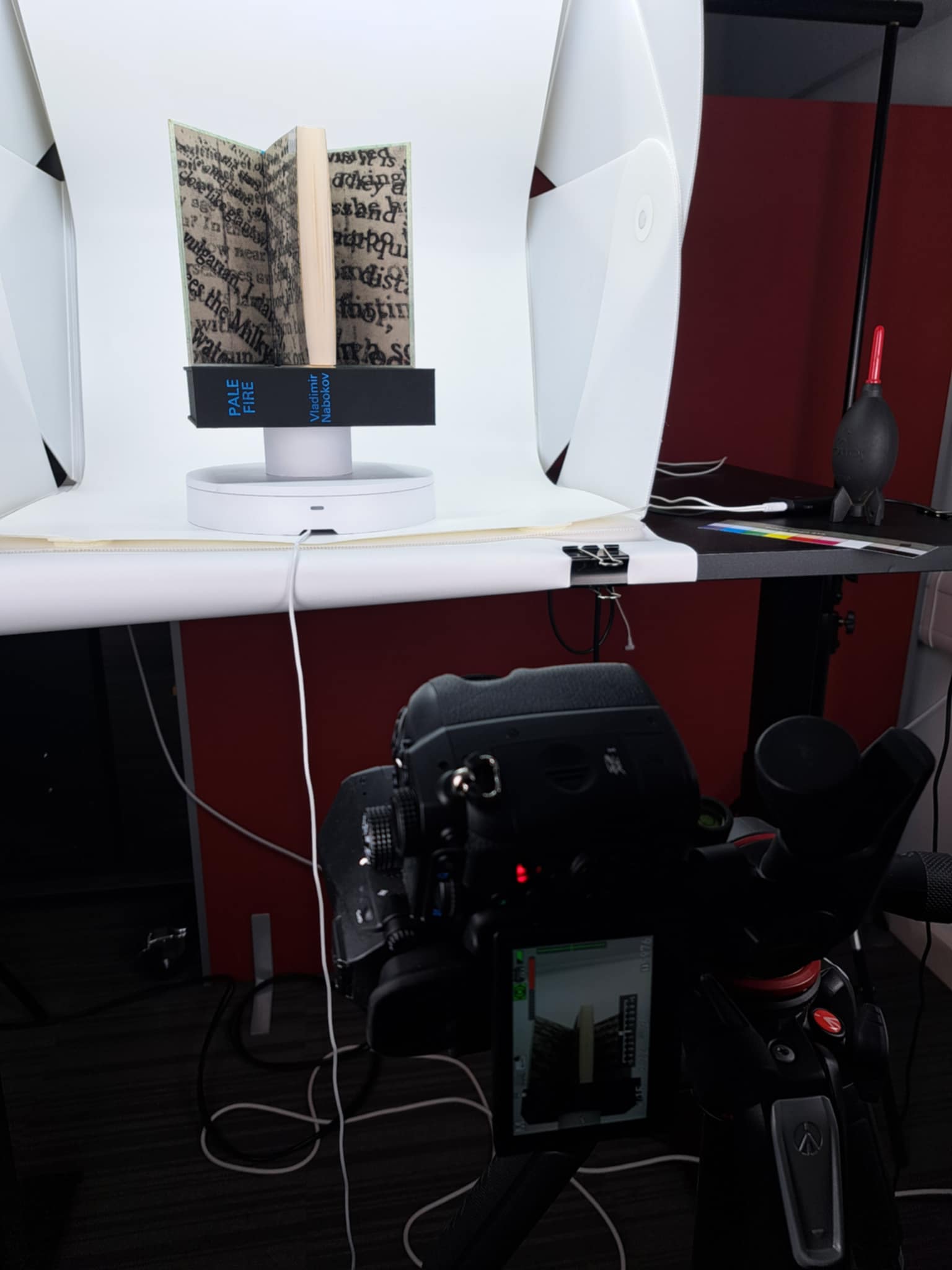
It occurred to me that standing the books on their boxes would allow us to include the fabulous designs of the latter in the models. Raising the boxes a few inches above the turntable enabled me to shoot up at an angle capturing the sides (although not the bottom) of the box. This was the method used for Pale Fire and Invitation to a Beheading.
The final models were uploaded to Sketchfab – the go-to 3D platform for Arts and Heritage. Sketchfab allows adjustments to how the model moves which enabled me to restrict the vertical movement of the books so the viewer cannot see the missing face of the box. You can however turn the models 360 degrees horizontally, and 180 vertically so you can see the front designs of the boxes from above. Information about the project, the bookbinders and 3D model creators, along with tags to make them searchable, were also added to make these incredible books available for all to examine in detail! You can view the 3D models here.
There is further information about the 3D methods mentioned above in my recent blog post.