
In VN’s novel Lolita (1955) the number 342 reappears three times. 342 Lawn Street is the address of the Haze house in Ramsdale. 342 is Humbert's and Lolita's room in The Enchanted Hunters (a hotel in Briceland where they spend their first night together). Between July 5 and November 18, 1949, Humbert registers (if not actually stays) at 342 hotels, motels and tourist homes. The number 342 seems to hint at Earth, Mars and Venus (the third, the fourth, and the second planets of the Solar System). On the other hand, 342 makes one think of Tri vstrechi ("The Three Meetings," 1852), a story by Turgenev, Chetyre dnya ("Four Days," 1877), a story by Garshin, and Dva poeta ("Two Poets," 1933), a sonnet by Balmont. Describing his visit to Ramsdale in September 1952, Humbert mentions a Turgenev story (The Three Meetings):
Should I enter my old house? As in a Turgenev story, a torrent of Italian music came from an open windowthat of the living room: what romantic soul was playing the piano where no piano had plunged and plashed on that bewitched Sunday with the sun on her beloved legs? All at once I noticed that from the lawn I had mown a golden-skinned, brown-haired nymphet of nine or ten, in white shorts, was looking at me with wild fascination in her large blue-black eyes. I said something pleasant to her, meaning no harm, an old-world compliment, what nice eyes you have, but she retreated in haste and the music stopped abruptly, and a violent-looking dark man, glistening with sweat, came out and glared at me. I was on the point of identifying myself when, with a pang of dream-embarrassment, I became aware of my mud-caked dungarees, my filthy and torn sweater, my bristly chin, my bum’s bloodshot eyes. Without saying a word, I turned and plodded back the way I had come. An aster-like anemic flower grew out of a remembered chink in the sidewalk. Quietly resurrected, Miss Opposite was being wheeled out by her nieces, onto her porch, as if it were a stage and I the star performer. Praying she would not call to me, I hurried to my car. What a steep little street. What a profound avenue. A red ticket showed between wiper and windshield; I carefully tore it into two, four, eight pieces. (2.33)
According to Humbert, it took him fifty-six days (eight weeks) to write Lolita:
When I started, fifty-six days ago, to write Lolita, first in the psychopathic ward for observation, and then in this well-heated, albeit tombal, seclusion, I thought I would use these notes in toto at my trial, to save not my head, of course, but my soul. In mind-composition, however, I realized that I could not parade living Lolita. I still may use parts of this memoir in hermetic sessions, but publication is to be deferred. (2.36)
But only fifty-two days pass between September 25, 1952 (the day of Quilty's murder and Humbert's arrest) and December 16, 1952 (the day of Humbert’s death). 52 + 4 = 56.
In his diary (the entry of July 10, 1933) Bunin says that Balmont had sent him a sonnet (entitled Dva poeta, "Two Poets") in which Balmont compares Bunin and himself to a lion and a tiger:
Бальмонт прислал мне сонет, в котором сравнивает себя и меня с львом и тигром.
ДВА ПОЭТА
Ив. Бунину
Мы - тигр и лев, мы - два царя земные.
Кто лев, кто тигр, не знаю, право, я.
В обоих - блеск и роскошь бытия,
И наш наряд - узоры расписные.
Мы оба пред врагом не склоним выи,
И в нас не кровь, а пламенней струя.
Пусть в львиной гриве молвь,- вся власть моя,-
В прыжке тигрином метче когти злые.
Не тигр и лев. Любой то лев, то тигр.
Но розны, от начала дней доныне,
Державы наши, царские пустыни.
И лучше, чем весь блеск звериных игр,-
Что оба слышим зов мы благостыни,
Призыв Звезды Единой в бездне синей.
Кламар, 1933, 5 июня К. Бальмонт.]
Я написал в ответ:
Милый! Пусть мы только псы
Все равно: как много шавок,
У которых только навык
Заменяет все красы.
In reply to Balmont Bunin wrote what seems to be the beginning of a sonnet: "My dear! Though we are only dogs, etc." Lolita's mother Charlotte dies under the wheels of a truck because of a neighbor's hysterical dog. William Blake's poem The Tyger was translated into Russian by Balmont. According to Humbert, he picked up Rita at a darkishly burning bar under the sign of the Tiger-moth:
She was twice Lolita’s age and three quarters of mine: a very slight, dark-haired, pale-skinned adult, weighing a hundred and five pounds, with charmingly asymmetrical eyes, and angular, rapidly sketched profile, and a most appealing ensellure to her supple back - I think she had some Spanish or Babylonian blood. I picked her up one depraved May evening somewhere between Montreal and New York, or more narrowly, between Toylestown and Blake, at a darkishly burning bar under the sign of the Tiger-moth, where she was amiably drunk: she insisted we had gone to school together, and she placed her trembling little hand on my ape paw. My senses were very slightly stirred but I decided to give her a try; I did – and adopted her as a constant companion. She was so kind, was Rita, such a good sport, that I daresay she would have given herself to any pathetic creature or fallacy, an old broken tree or a bereaved porcupine, out of sheer chumminess and compassion.
When I first met her she had but recently divorced her third husband – and a little more recently had been abandoned by her seventh cavalier servant – the others, the mutables, were too numerous and mobile to tabulate. Her brother was – and no doubt still is – a prominent, pasty-faced, suspenders-and-painted-tie-wearing politician, mayor and boaster of his ball-playing, Bible-reading, grain-handling home town. For the last eight years he had been paying his great little sister several hundred dollars per month under the stringent condition that she would never never enter great little Grainball City. She told me, with wails of wonder, that for some God-damn reason every new boy friend of hers would first of all take her Grainball-ward: it was a fatal attraction; and before she knew what was what, she would find herself sucked into the lunar orbit of the town, and would be following the flood-lit drive that encircled it “going round and round,” as she phrased it, “like a God-damn mulberry moth.” (2.26)
The garden tiger moth or great tiger moth (Arctia caja) is a moth of the family Erebidae:

Bombyx is the genus of true silk moths or mulberry silk moths of the famiy Bombycidae, also known as silkworms, which are the larvae or caterpillars of silk moths. The genus was erected as a subgenus by Carl Linnaeus in his 10th edition of Systema Naturae (1758):
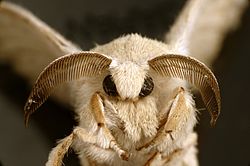
Bombyx mori, the silk moth
Tiger-moth and Toylestown bring to mind tigr (a tiger) mentioned by Bunin in his memoir essay Tolstoy (1937):
Бросив торговлю (в которой я так запутал счёты, несмотря на их малые размеры, что порою подумывал повеситься от стыда, от беспомощности), я переехал на жительство в Москву, но и там всё ещё пытался уверить себя, что я брат и единомышленник руководителей «Посредника» и тех, что постоянно торчали в его помещении, наставляя друг друга насчёт «доброй жизни».
Там-то я и видел его ещё несколько раз. Он туда иногда заходил, вернее, забегал (ибо он ходил удивительно легко и быстро) и, не снимая полушубка, сидел час или два, со всех сторон окружённый «братией», делавшей ему порою такие вопросы:
Лев Николаевич, но что же я должен был бы делать, неужели убивать, если бы на меня напал, например, тигр?
Он в таких случаях только смущённо улыбался:
– Да какой же тигр, откуда тигр? Я вот за всю жизнь не встретил ни одного тигра...
Humbert was born in 1910, in Paris. Leo Tolstoy (who was born on August 28, 1828) died on Nov. 7, 1910. In his autobiography Speak, Memory (1951) VN describes his first erotic experience and quotes the words of his father, "Tolstoy vient de mourir:"
High-principled but rather simple Lenski, who was abroad for the first time, had some trouble keeping the delights of sightseeing in harmony with his pedagogical duties. We took advantage of this and guided him toward places where our parents might not have allowed us to go. He could not resist the Wintergarten, for instance, and so, one night, we found ourselves there, drinking ice-chocolate in an orchestra box. The show developed on the usual lines: a juggler in evening clothes; then a woman, with flashes of rhinestones on her bosom, trilling a concert aria in alternating effusions of green and red light; then a comic on roller skates. Between him and a bicycle act (of which more later) there was an item on the program called “The Gala Girls,” and with something of the shattering and ignominious physical shock I had experienced when coming that cropper on the rink, I recognized my American ladies in the garland of linked, shrill-voiced, shameless “girls,” all rippling from left to right, and then from right to left, with a rhythmic rising of ten identical legs that shot up from ten corollas of flounces. I located my Louise’s face—and knew at once that it was all over, that I had lost her, that I would never forgive her for singing so loudly, for smiling so redly, for disguising herself in that ridiculous way so unlike the charm of either “proud Creoles” or “questionable señoritas.” I could not stop thinking of her altogether, of course, but the shock seems to have liberated in me a certain inductive process, for I soon noticed that any evocation of the feminine form would be accompanied by the puzzling discomfort already familiar to me. I asked my parents about it (they had come to Berlin to see how we were getting along) and my father ruffled the German newspaper he had just opened and replied in English (with the parody of a possible quotation—a manner of speech he often adopted in order to get going): “That, my boy, is just another of nature’s absurd combinations, like shame and blushes, or grief and red eyes.” “Tolstoy vient de mourir,” he suddenly added, in another, stunned voice, turning to my mother.
“Da chto tï [something like “good gracious”]!” she exclaimed in distress, clasping her hands in her lap. “Pora domoy [Time to go home],” she concluded, as if Tolstoy’s death had been the portent of apocalyptic disasters. (Chapter Ten, 3)
“Tolstoy vient de mourir” brings to mind “vient de,” with the infinitive, in Lolita:
Feeling I was losing my time, I drove energetically to the downtown hotel where I had arrived with a new bag more than five years before. I took a room, made two appointments by telephone, shaved, bathed, put on black clothes and went down for a drink in the bar. Nothing had changed. The barroom was suffused with the same dim, impossible garnet-red light that in Europe years ago went with low haunts, but here meant a bit of atmosphere in a family hotel. I sat at the same little table where at the very start of my stay, immediately after becoming Charlotte’s lodger, I had thought fit to celebrate the occasion by suavely sharing with her half a bottle of champagne, which had fatally conquered her poor brimming heart. As then, a moon-faced waiter was arranging with stellar care fifty sherries on a round tray for a wedding party. Murphy-Fantasia, this time. It was eight minutes to three. As I walked though the lobby, I had to skirt a group of ladies who with mille grâces were taking leave of each other after a luncheon party. With a harsh cry of recognition, one pounced upon me. She was a stout, short woman in pearl-gray, with a long, gray, slim plume to her small hat. It was Mrs. Chatfield. She attacked me with a fake smile, all aglow with evil curiosity. (Had I done to Dolly, perhaps, what Frank Laselle, a fifty-year-old mechanic, had done o eleven-year-old Sally Horner in 1948?) Very soon I had that avid glee well under control. She thought I was in California. How was - ? With exquisite pleasure I informed her that my stepdaughter had just married a brilliant young mining engineer with a hush-hush job in the Northwest. She said she disapproved of such early marriages, she would never let her Phillys, who was now eighteen -
“Oh yes, of course,” I said quietly. “I remember Phyllis. Phyllis and Camp Q. Yes, of course. By the way, did she ever tell you how Charlie Holmes debauched there his mother’s little charges?”
Mrs. Chatfield’s already broken smile now disintegrated completely.
“For shame,” she cried, “for shame, Mr. Humbert! The poor boy has just been killed in Korea.”
I said didn’t she think “vient de,” with the infinitive, expressed recent events so much more neatly than the English “just,” with the past? But I had to be trotting off, I said. (2.33)
Note that on Demonia (in VN's novel Ada, 1969, Earth's twin planet also known as Antiterra) Chekhov's play Tri sestry ("The Three Sisters," 1901) is known as Four Sisters:
The beginning of Ada’s limelife in 1891 happened to coincide with the end of her mother’s twenty-five-year-long career. What is more, both appeared in Chekhov’s Four Sisters. Ada played Irina on the modest stage of the Yakima Academy of Drama in a somewhat abridged version which, for example, kept only the references to Sister Varvara, the garrulous originalka (‘odd female’ — as Marsha calls her) but eliminated her actual scenes, so that the title of the play might have been The Three Sisters, as indeed it appeared in the wittier of the local notices. It was the (somewhat expanded) part of the nun that Marina acted in an elaborate film version of the play; and the picture and she received a goodly amount of undeserved praise. (2.9)
Tri goda ("Three Years," 1895) is a novella by Chekhov.