
At the beginning of his poem John Shade (the poet in VN's novel Pale Fire, 1962) says that from the inside, too, he would duplicate himself, his lamp, an apple on a plate:
I was the shadow of the waxwing slain
By the false azure in the windowpane;
I was the smudge of ashen fluff - and I
Lived on, flew on, in the reflected sky.
And from the inside, too, I'd duplicate
Myself, my lamp, an apple on a plate:
Uncurtaining the night, I'd let dark glass
Hang all the furniture above the grass,
And how delightful when a fall of snow
Covered my glimpse of lawn and reached up so
As to make chair and bed exactly stand
Upon that snow, out in that crystal land! (1-12)
In Canto One of his poem Shade describes his childhood and mentions his dear bizarre Aunt Maud and a still life in her style:
I was brought up by dear bizarre Aunt Maud,
A poet and a painter with a taste
For realistic objects interlaced
With grotesque growths and images of doom.
She lived to hear the next babe cry. Her room
We've kept intact. Its trivia create
A still life in her style: the paperweight
Of convex glass enclosing a lagoon,
The verse book open at the Index (Moon,
Moonrise, Moor, Moral), the forlorn guitar,
The human skull; and from the local Star
A curio: Red Sox Beat Yanks 5-4
On Chapman's Homer, thumbtacked to the door. (ll. 86-98)
Apples and Grapes in a Basket (1876) is a still life oil-on-canvas painting by Alfred Sisley (a British Impressionist artist, 1839-1899, active in France):
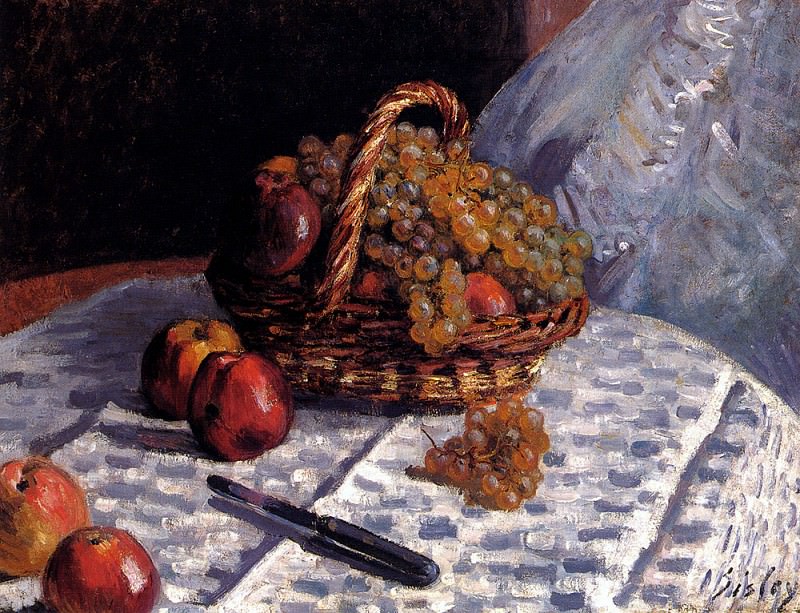
Alfred Sisley's still lives include Grapes and Walnuts on a Table (1876). Describing Eystein's portrait of decrepit Count Kernel (a former Keeper of the Treasure), Kinbote (Shade’s mad commentator who imagines that he is Charles the Beloved, the last self-exiled king of Zembla) mentions a plate painted by the artist with the beautifully executed, twin-lobed, brainlike, halved kernel of a walnut:
Under the unshakable but quite erroneous belief that the crown jewels were concealed somewhere in the Palace, the new administration had engaged a couple of foreign experts (see note to line 681) to locate them. The good work had been going on for a month. The two Russians, after practically dismantling the Council Chamber and several other rooms of state, had transferred their activities to that part of the gallery where the huge oils of Eystein had fascinated several generations of Zemblan princes and princesses. While unable to catch a likeness, and therefore wisely limiting himself to a conventional style of complimentary portraiture, Eystein showed himself to be a prodigious master of the trompe l'oeil in the depiction of various objects surrounding his dignified dead models and making them look even deader by contrast to the fallen petal or the polished panel that he rendered with such love and skill. But in some of these portraits Eystein had also resorted to a weird form of trickery: among his decorations of wood or wool, gold or velvet, he would insert one which was really made of the material elsewhere imitated by paint. This device which was apparently meant to enhance the effect of his tactile and tonal values had, however, something ignoble about it and disclosed not only an essential flaw in Eystein's talent, but the basic fact that "reality" is neither the subject nor the object of true art which creates its own special reality having nothing to do with the average "reality" perceived by the communal eye. But to return to our technicians whose tapping is approaching the gallery toward the bend where the King and Odon stand ready to part. At this spot hung a portrait representing a former Keeper of the Treasure, decrepit Count Kernel, who was painted with fingers resting lightly on an embossed and emblazoned box whose side facing the spectator consisted of an inset oblong made of real bronze, while upon the shaded top of the box, drawn in perspective, the artist had pictured a plate with the beautifully executed, twin-lobed, brainlike, halved kernel of a walnut.
"They are in for a surprise," murmured Odon in his mother tongue, while in a corner the fat guard was going through some dutiful, rather lonesome, rifle-butt-banging formalities.
The two Soviet professionals could be excused for assuming they would find a real receptacle behind the real metal. At the present moment they were about to decide whether to pry out the plaque or take down the picture; but we can anticipate a little and assure the reader that the receptacle, an oblong hole in the wall, was there all right; it contained nothing, however, except the broken bits of a nutshell. (note to Line 130)
In his note to Line 12 (that crystal land) Kinbote says that he has not shaved now for a year. In Canto Four of his poem Shade describes shaving:
Now I shall speak... Better than any soap
Is the sensation for which poets hope
When inspiration and its icy blaze,
The sudden image, the immediate phrase
Over the skin a triple ripple send
Making the little hairs all stand on end
As in the enlarged animated scheme
Of whiskers mowed when held up by Our Cream. (ll. 915-922)
In his note to Line 920 (little hairs stand on end) Kinbote writes:
Alfred Housman (1859-1939), whose collection The Shropshire Lad vies with the In Memoriam of Alfred Tennyson (1809-1892) in representing, perhaps (no, delete this craven "perhaps"), the highest achievement of English poetry in a hundred years, says somewhere (in a foreword?) exactly the opposite: The bristling of thrilled little hairs obstructed his barbering; but since both Alfreds certainly used an Ordinary Razor, and John Shade an ancient Gillette, the discrepancy may have been due to the use of different instruments.
Alfred Housman and Alfred Tennyson (the author of Maud, 1855) are the namesakes and compatriots of Alfred Sisley (who was born in 1839, twenty years after Tennyson's birth and twenty years before Housman's birth, in Paris). The author of Pale Fire, VN was born in 1899, a hundred years after Pushkin's birth. In his Don Juan Byron mentions a Russian nobleman Mouskin Pouskin. The English surname Sisley makes one think of chisla, plural of chislo (the Russian word for "number").