
Describing his contacts with publishers, Kinbote (in VN's novel Pale Fire, 1962, Shade’s mad commentator who imagines that he is Charles the Beloved, the last self-exiled king of Zembla) compares himself to an exiled prince who is unaware of the Golconda in his cuff links:
Imagine a soft, clumsy giant; imagine a historical personage whose knowledge of money is limited to the abstract billions of a national debt; imagine an exiled prince who is unaware of the Golconda in his cuff links! This is to say - oh, hyperbolically - that I am the most impractical fellow in the world. Between such a person and an old fox in the book publishing business, relations are at first touchingly carefree and chummy, with expansive banterings and all sorts of amiable tokens. I have no reason to suppose that anything will ever happen to prevent this initial relationship with good old Frank, my present publisher, from remaining a permanent fixture. (Foreword)
Golconda (1953) is an oil painting on canvas by René Magritte (a Belgian surrealist artist, 1898-1967):
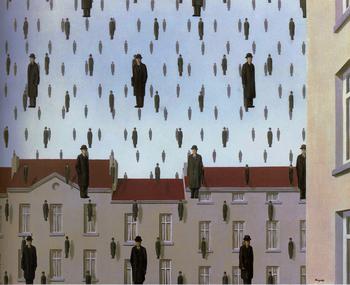
Magritte is the author of Les Menottes de Cuivre ("The Copper Handcuffs," 1931), a reimagined version of the classical sculpture, Venus de Milo:

Venus de Milo with Drawers (1936) is a sculpture by Salvador Dali (a Spanish surrealist artist, 1904-1989):

Describing his first physical contact with Lolita, Humbert Humbert (the narrator and main character in VN’s novel Lolita, 1955) mentions the picture in Lolita's magazine: a surrealist painter relaxing, supine, on a beach, and near him, likewise supine, a plaster replica of the Venus di Milo, half-buried in sand:
I want my learned readers to participate in the scene I am about to replay; I want them to examine its every detail and see for themselves how careful, how chaste, the whole wine-sweet event is if viewed with what my lawyer has called, in a private talk we have had, “impartial sympathy.” So let us get started. I have a difficult job before me.
Main character: Humbert the Hummer. Time: Sunday morning in June. Place: sunlit living room. Props: old, candy-striped davenport, magazines, phonograph, Mexican knickknacks (the late Mr. Harold E. Haze - God bless the good man - had engendered my darling at the siesta hour in a blue-washed room, on a honeymoon trip to Vera Cruz, and mementoes, among these Dolores, were all over the place). She wore that day a pretty print dress that I had seen on her once before, ample in the skirt, tight in the bodice, short-sleeved, pink, checkered with darker pink, and, to complete the color scheme, she had painted her lips and was holding in her hollowed hands a beautiful, banal, Eden-red apple. She was not shod, however, for church. And her white Sunday purse lay discarded near the phonograph.
My heart beat like a drum as she sat down, cool skirt ballooning, subsiding, on the sofa next to me, and played with her glossy fruit. She tossed it up into the sun-dusted air, and caught it - it made a cupped polished plop.
Humbert Humbert intercepted the apple.
“Give it back,”—she pleaded, showing the marbled flush of her palms. I produced Delicious. She grasped it and bit into it, and my heart was like snow under thin crimson skin, and with the monkeyish nimbleness that was so typical of that American nymphet, she snatched out of my abstract grip the magazine I had opened (pity no film had recorded the curious pattern, the monogrammic linkage of our simultaneous or overlapping moves). Rapidly, hardly hampered by the disfigured apple she held, Lo flipped violently through the pages in search of something she wished Humbert to see. Found it at last. I faked interest by bringing my head so close that her hair touched my temple and her arm brushed my cheek as she wiped her lips with her wrist. Because of the burnished mist through which I peered at the picture, I was slow in reacting to it, and her bare knees rubbed and knocked impatiently against each other. Dimly there came into view: a surrealist painter relaxing, supine, on a beach, and near him, likewise supine, a plaster replica of the Venus di Milo, half-buried in sand. Picture of the Week, said the legend. I whisked the whole obscene thing away. Next moment, in a sham effort to retrieve it, she was all over me. Caught her by her thin knobby wrist. The magazine escaped to the floor like a flustered fowl. She twisted herself free, recoiled, and lay back in the right-hand corner of the davenport. Then, with perfect simplicity, the impudent child extended her legs across my lap. (1.13)
The apple intercepted by Humbert Humbert brings to mind the fortress of an apple that Shade finds so difficult to attack:
A few days later, however, namely on Monday, February 16, I was introduced to the old poet at lunch time in the faculty club. "At last presented credentials," as noted, a little ironically, in my agenda. I was invited to join him and four or five other eminent professors at his usual table, under an enlarged photograph of Wordsmith College as it was, stunned and shabby, on a remarkably gloomy summer day in 1903. His laconic suggestion that I "try the pork" amused me. I am a strict vegetarian, and I like to cook my own meals. Consuming something that had been handled by a fellow creature was, I explained to the rubicund convives, as repulsive to me as eating any creature, and that would include - lowering my voice - the pulpous pony-tailed girl student who served us and licked her pencil. Moreover, I had already finished the fruit brought with me in my briefcase, so I would content myself, I said, with a bottle of good college ale. My free and simple demeanor set everybody at ease. The usual questions were fired at me about eggnogs and milkshakes being or not being acceptable to one of my persuasion. Shade said that with him it was the other way around: he must make a definite effort to partake of a vegetable. Beginning a salad, was to him like stepping into sea water on a chilly day, and he had always to brace himself in order to attack the fortress of an apple. I was not yet used to the rather fatiguing jesting and teasing that goes on among American intellectuals of the inbreeding academic type and so abstained from telling John Shade in front of all those grinning old males how much I admired his work lest a serious discussion of literature degenerate into mere facetiation. Instead I asked him about one of my newly acquired students who also attended his course, a moody, delicate, rather wonderful boy; but with a resolute shake of his hoary forelock the old poet answered that he had ceased long ago to memorize faces and names of students and that the only person in his poetry class whom he could visualize was an extramural lady on crutches. "Come, come," said Professor Hurley, "do you mean, John, you really don't have a mental or visceral picture of that stunning blonde in the black leotard who haunts Lit. 202?" Shade, all his wrinkles beaming, benignly tapped Hurley on the wrist to make him stop. Another tormentor inquired if it was true that I had installed two ping-pong tables in my basement. I asked, was it a crime? No, he said, but why two? "Is that a crime?" I countered, and they all laughed. (Foreword)
Good old Frank (as Kinbote calls his present publisher) makes one think of big Frank (Mrs. Hays's beau, a robust and kindly trucker) in Lolita:
I heard the sound of whistling lips nearing the half-opened door of my cabin, and then a thump upon it.
It was big Frank. He remained framed in the opened door, one hand on its jamb, leaning forward a little.
Howdy. Nurse Lore was on the telephone. She wanted to know was I better and would I come today?
At twenty paces Frank used to look a mountain of health; at five, as now, he was a ruddy mosaic of scars - had been blown through a wall overseas; but despite nameless injuries he was able to man a tremendous truck, fish, hunt, drink, and buoyantly dally with roadside ladies. That day, either because it was such a great holiday, or simply because he wanted to divert a sick man, he had taken off the glove he usually wore on his left hand (the one pressing against the side of the door) and revealed to the fascinated sufferer not only an entire lack of fourth and fifth fingers, but also a naked girl, with cinnabar nipples and indigo delta, charmingly tattooed on the back of his crippled hand, its index and middle digit making her legs while his wrist bore her flower-crowned head. Oh, delicious… reclining against the woodwork, like some sly fairy.
I asked him to tell Mary Lore I would stay in bed all day and would get into touch with my daughter sometime tomorrow if I felt probably Polynesian.
He noticed the direction of my gaze and made her right hip twitch amorously.
“Okey-dokey,” big Frank sang out, slapped the jamb, and whistling, carried my message away, and I went on drinking, and by morning the fever was gone, and although I was as limp as a toad, I put on the purple dressing gown over my maize yellow pajamas, and walked over to the office telephone. Everything was fine. A bright voice informed me that yes, everything was fine, my daughter had checked out the day before, around two, her uncle, Mr. Gustave, had called for her with a cocker spaniel pup and a smile for everyone, and a black Caddy Lack, and had paid Dolly’s bill in cash, and told them to tell me I should not worry, and keep warm, they were at Grandpa’s ranch as agreed.
Elphinstone was, and I hope still is, a very cute little town. It was spread like a maquette, you know, with its neat greenwool trees and red-roofed houses over the valley floor and I think I have alluded earlier to its model school and temple and spacious rectangular blocks, some of which were, curiously enough, just unconventional pastures with a mule or a unicorn grazing in the young July morning mist. Very amusing: at one gravelgroaning sharp turn I sideswiped a parked car but said to myself telestically - and, telepathically (I hoped), to its gesticulating owner - that I would return later, address Bird School, Bird, New Bird, the gin kept my heart alive but bemazed my brain, and after some lapses and losses common to dream sequences, I found myself in the reception room, trying to beat up the doctor, and roaring at people under chairs, and clamoring for Mary who luckily for her was not there; rough hands plucked at my dressing gown, ripping off a pocket, and somehow I seem to have been sitting on a bald brown-headed patient, whom I had mistaken for Dr. Blue, and who eventually stood up, remarking with a preposterous accent: “Now, who is neurotic, I ask?”and then a gaunt unsmiling nurse presented me with seven beautiful, beautiful books and the exquisitely folded tartan lap robe, and demanded a receipt; and in the sudden silence I became aware of a policeman in the hallway, to whom my fellow motorist was pointing me out, and meekly I signed the very symbolic receipt, thus surrendering my Lolita to all those apes. But what else could I do? One simple and stark thought stood out and this was: “Freedom for the moment is everything.” One false move - and I might have been made to explain a life of crime. So I simulated a coming out of a daze. To my fellow motorist I paid what he thought was fair. To Dr. Blue, who by then was stroking my hand, I spoke in tears of the liquor I bolstered too freely a tricky but not necessarily diseased heart with. To the hospital in general I apologized with a flourish that almost bowled me over, adding however that I was not on particularly good terms with the rest of the Humbert clan. To myself I whispered that I still had my gun, and was still a free man - free to trace the fugitive, free to destroy my brother. (2.22)
Big Frank makes one think of Mr. Big, the Dwarf's name in Ray Bradbury's story The Dwarf (1953). The Russian word for "dwarf" is karlik. According to Kinbote, on his deathbed Conmal (the Zemblan translator of Shakespeare, 1855-1955) called his nephew, Charles Xavier Vseslav (aka Charles the Beloved), "Karlik:"
To return to the King: take for instance the question of personal culture. How often is it that kings engage in some special research? Conchologists among them can be counted on the fngers of one maimed hand. The last king of Zembla - partly under the influence of his uncle Conmal, the great translator of Shakespeare (see notes to lines 39 - 40 and 962), had become, despite frequent migraines, passionately addicted to the study of literature. At forty, not long before the collapse of his throne, he had attained such a degree of scholarship that he dared accede to his venerable uncle's raucous dying request: "Teach, Karlik!" Of course, it would have been unseemly for a monarch to appear in the robes of learning at a university lectern and present to rosy youths Finnegans Wake as a monstrous extension of Angus MacDiarmid's "incoherent transactions" and of Southey's Lingo-Grande ("Dear Stumparumper," etc.) or discuss the Zemblan variants, collected in 1798 by Hodinski, of the Kongs-skugg-sio (The Royal Mirror), an anonymous masterpiece of the twelfth century. Therefore he lectured under an assumed name and in a heavy make-up, with wig and false whiskers. All brown-bearded, apple-checked, blue-eyed Zemblans look alike, and I who have not shaved now for a year, resemble my disguised king (see also note to line 894). (note to Line 12)
In Canto Three of his poem Shade describes his heart attack and mentions Hurricane Lolita that swept from Florida to Maine:
It was a year of Tempests: Hurricane
Lolita swept from Florida to Maine.
Mars glowed. Shahs married. Gloomy Russians spied.
Lang made your portrait. And one night I died. (ll. 679-82)
In his commentary Kinbote writes:
Major hurricanes are given feminine names in America. The feminine gender is suggested not so much by the sex of furies and harridans as by a general professional application. Thus any machine is a she to its fond user, and any fire (even a "pale" one!) is she to the fireman, as water is she to the passionate plumber. Why our poet chose to give his 1958 hurricane a little-used Spanish name (sometimes given to parrots) instead of Linda or Lois, is not clear. (note to Line 680)