
Describing his life with Charlotte (Lolita's mother) in Ramsdale (a small town in New England), Humbert Humbert (the narrator and main character in VN’s novel Lolita, 1955) mentions Hourglass Lake (a woodlake near Ramsdale):
There was a woodlake (Hourglass Lake - not as I had thought it was spelled) a few miles from Ramsdale, and there was one week of great heat at the end of July when we drove there daily. I am now obliged to describe in some tedious detail our last swim there together, one tropical Tuesday morning. (1.20)
The week of scattered showers and shadows which elapsed after our last visit to the motionless sands of Hourglass Lake was one of the gloomiest I can recall. Then came two or three dim rays of hope - before the ultimate sunburst. (1.21)
Humbert Humbert's and Charlotte's last swim in Hourglass Lake takes place on Tuesday, July 29, 1947. Le sablier (or The Hourglass / Le sablier-compte-fils, 1936) is a pen-and-ink drawing and photograph by Man Ray (an American visual artist, born Emmanuel Radnitzky, 1890-1976):
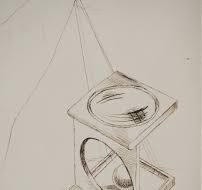
It was included in Les Mains libres ("The Free Hands," 1937), a book by Paul Éluard (a French Surrealist poet, 1895-1952) and Man Ray. In his sonnet Le Rêve d'un Curieux ("The Dream of a Curious Man") included in Les Fleurs du mal ("The Flowers of Evil," 1857) and dedicated to Félix Nadar (a French photographer and cartoonist, 1820-1910) Charles Baudelaire (a French poet, 1821-1867) mentions le fatal sablier (the fatal hourglass):
À Félix Nadar
Connais-tu, comme moi, la douleur savoureuse
Et de toi fais-tu dire: «Oh! l'homme singulier!»
— J'allais mourir. C'était dans mon âme amoureuse
Désir mêlé d'horreur, un mal particulier;
Angoisse et vif espoir, sans humeur factieuse.
Plus allait se vidant le fatal sablier,
Plus ma torture était âpre et délicieuse;
Tout mon coeur s'arrachait au monde familier.
J'étais comme l'enfant avide du spectacle,
Haïssant le rideau comme on hait un obstacle...
Enfin la vérité froide se révéla:
J'étais mort sans surprise, et la terrible aurore
M'enveloppait. — Eh quoi! n'est-ce donc que cela?
La toile était levée et j'attendais encore.
Do you know as I do, delectable suffering?
And do you have them say of you: "O! the strange man!"
— I was going to die. In my soul, full of love,
A peculiar illness; desire mixed with horror,
Anguish and bright hopes; without internal strife.
The more the fatal hour-glass continued to flow,
The fiercer and more delightful grew my torture;
My heart was being torn from this familiar world.
I was like a child eager for the play,
Hating the curtain as one hates an obstacle...
Finally the cold truth revealed itself:
I had died and was not surprised; the awful dawn
Enveloped me. — What! is that all there is to it?
The curtain had risen and I was still waiting.
(tr. W. Aggeler)
In his little pocket diary that he kept in Ramsdale as Charlotte's lodger Humbert Humbert describes a dream ride around the lake:
Friday. I long for some terrific disaster. Earthquake. Spectacular explosion. Her mother is messily but instantly and permanently eliminated, along with everybody else for miles around. Lolita whimpers in my arms. A free man, I enjoy her among the ruins. Her surprise, my explanations, demonstrations, ullulations. Idle and idiotic fancies! A brave Humbert would have played with her most disgustingly (yesterday, for instance, when she was again in my room to show me her drawings, school-artware); he might have bribed her – and got away with it. A simpler and more practical fellow would have soberly stuck to various commercial substitutes – if you know where to go, I don’t. Despite my manly looks, I am horribly timid. My romantic soul gets all clammy and shivery at the thought of running into some awful indecent unpleasantness. Those ribald sea monsters. ‘Mais allez-y, allez-y!’ Annabel skipping on one foot to get into her shorts, I seasick with rage, trying to screen her.
Same date, later, quite late. I have turned on the light to take down a dream. It had an evident antecedent. Haze at dinner had benevolently proclaimed that since the weather bureau promised a sunny weekend we would go to the lake Sunday after church. As I lay in bed, erotically musing before trying to go to sleep, I thought of a final scheme how to profit by the picnic to come. I was aware that mother Haze hated my darling for her being sweet on me. So I planned my lake day with a view to satisfying the mother. To her alone would I talk; but at some appropriate moment I would say I had left my wrist watch or my sunglasses in that glade yonder - and plunge with my nymphet into the wood. Reality at this juncture withdrew, and the Quest for the Glasses turned into a quiet little orgy with a singularly knowing, cheerful, corrupt and compliant Lolita behaving as reason knew she could not possibly behave. At 3 a. m. I swallowed a sleeping pill, and presently, a dream that was not a sequel but a parody revealed to me, with a kind of meaningful clarity, the lake I had never yet visited: it was glazed over with a sheet of emerald ice, and a pockmarked Eskimo was trying in vain to break it with a pickax, although imported mimosas and oleanders flowered on its gravelly banks. I am sure Dr. Blanche Schwarzmann would have paid me a sack of schillings for adding such a libidream to her files. Unfortunately, the rest of it was frankly eclectic. Big Haze and little Haze rode on horseback around the lake, and I rode too, dutifully bobbing up and down, bowlegs astraddle although there was no horse between them, only elastic air - one of those little omissions due to the absentmindedness of the dream agent. (1.11)
In his foreword to Humbert Humbert's manuscript John Ray, Jr. mentions Dr. Blanche Schwarzmann:
Viewed simply as a novel, “Lolita” deals with situations and emotions that would remain exasperatingly vague to the reader had their expression been etiolated by means of platitudinous evasions. True, not a single obscene term is to be found in the whole work; indeed, the robust philistine who is conditioned by modern conventions into accepting without qualms a lavish array of four-letter words in a banal novel, will be quite shocked by their absence here. If, however, for this paradoxical prude’s comfort, an editor attempted to dilute or omit scenes that a certain type of mind might call “aphrodisiac” (see in this respect the monumental decision rendered December 6, 1933, by Hon. John M. Woolsey in regard to another, considerably more outspoken, book), one would have to forego the publication of “Lolita” altogether, since those very scenes that one might inpetly accuse of sensuous existence of their own, are the most strictly functional ones in the development of a tragic tale tending unswervingly to nothing less than a moral apotheosis. The cynic may say that commercial pornography makes the same claim; the learned may counter by asserting that “H. H.”‘s impassioned confession is a tempest in a test tube; that at least 12% of American adult males - a “conservative” estimate according to Dr. Blanche Schwarzmann (verbal communication) - enjoy yearly, in one way or another, the special experience “H. H.” describes with such despare; that had our demented diarist gone, in the fatal summer of 1947, to a competent psycho-pathologist, there would have been no disaster; but then, neither would there have been this book.