
When Humbert Humbert (the narrator and main character in VN's novel Lolita, 1955) visits Lolita (now married to Dick Schiller and big with child) in Coalmont, Lolita calls her husband "a lamb:"
She was, as I say, talking. It now came in a relaxed flow. He was the only man she had ever been crazy about. What about Dick? Oh, Dick was a lamb, they were quite happy together, but she meant something different. And I had never counted, of course?
She considered me as if grasping all at once the incredible - and somehow tedious, confusing and unnecessary - fact that the distant, elegant, slender, forty-year-old valetudinarian in velvet coat sitting beside her had known and adored every pore and follicle of her pubescent body. In her washed-out gray eyes, strangely spectacled, our poor romance was for a moment reflected, pondered upon, and dismissed like a dull party, like a rainy picnic to which only the dullest bores had come, like a humdrum exercise, like a bit of dry mud caking her childhood. (2.29)
The Pet-Lamb (1800) is a pastoral poem by William Wordsworth (an English poet, 1770-1850). A child of beauty rare who feeds a mountain lamb, little Barbara Lewthwaite (the girl's name in Wordsworth's poem) is a namesake of Barbara Burke, Lolita's companion in Camp Q:
Barbara Burke, a sturdy blond, two years older than Lo and by far the camp’s best swimmer, had a very special canoe which she shared with Lo “because I was the only other girl who could make Willow Island” (some swimming test, I imagine). Through July, every morning - mark, reader, every blessed morning - Barbara and Lo would be helped to carry the boat to Onyx or Eryx (two small lakes in the wood) by Charlie Holmes, the camp mistress’ son, aged thirteen and the only human male for a couple of miles around (excepting an old meek stone-deaf handyman, and a farmer in an old Ford who sometimes sold the campers eggs as farmers will); every morning, oh my reader, the three children would take a short cut through the beautiful innocent forest brimming with all the emblems of youth, dew, birdsongs, and at one point, among the luxuriant undergrowth, Lo would be left as sentinel, while Barbara and the boy copulated behind a bush.
At first, Lo had refused “to try what it was like,” but curiosity and camaraderie prevailed, and soon she and Barbara were doing it by turns with the silent, coarse and surly but indefatigable Charlie, who had as much sex appeal as a raw carrot but sported a fascinating collection of contraceptives which he used to fish out of a third nearby lake, a considerably larger and more populous one, called Lake Climax, after the booming young factory town of that name. Although conceding it was “sort of fun” and “fine for the complexion,” Lolita, I am glad to say, held Charlie’s mind and manners in the greatest contempt. Nor had her temperament been roused by that filthy fiend. In fact, I think he had rather stunned it, despite the “fun.” (1.32)
A Lake poet, Wordsworth is the author of The Oak of Guernica (1810), a poem reflecting on the historic Basque symbol of liberty and lamenting its potential loss during the Peninsular Wars:
Oak of Guernica! Tree of holier power
Than that which in Dodona did enshrine
(So faith too fondly deemed) a voice divine
Heard from the depths of its aerial bower—
How canst thou flourish at this blighting hour?
What hope, what joy can sunshine bring to thee,
Or the soft breezes from the Atlantic sea,
The dews of morn, or April's tender shower?
Stroke merciful and welcome would that be
Which should extend thy branches on the ground,
If never more within their shady round
Those lofty-minded Lawgivers shall meet,
Peasant and lord, in their appointed seat,
Guardians of Biscay's ancient liberty.
Guernica (1937) is a famous painting by Pablo Picasso (a Spanish painter who lived in France, 1881-1973). Describing Lolita's illness and hospitalization in Elphinstone, Humbert mentions nurse Mary Lore (whose sister Ann works at Ponderosa Lodge) and her Basque father, lonely Joseph Lore, who is dreaming of Oloron, Lagore, Rolas - or seducing a ewe:
Mrs. Hays, the brisk, briskly rouged, blue-eyed widow who ran the motor court, asked me if I were Swiss perchance, because her sister had married a Swiss ski instructor. I was, whereas my daughter happened to be half Irish. I registered, Hays gave me the key and a tinkling smile, and, still twinkling, showed me where to park the car; Lo crawled out and shivered a little: the luminous evening air was decidedly crisp. Upon entering the cabin, she sat down on a chair at a card table, buried her face in the crook of her arm and said she felt awful. Shamming, I thought, shamming, no doubt, to evade my caresses; I was passionately parched; but she began to whimper in an unusually dreary way when I attempted to fondle her. Lolita ill. Lolita dying. Her skin was scalding hot! I took her temperature, orally, then looked up a scribbled formula I fortunately had in a jotter and after laboriously reducing the, meaningless to me, degrees Fahrenheit to the intimate centigrade of my childhood, found she had 40.4, which at least made sense. Hysterical little nymphs might, I knew, run up all kinds of temperatureeven exceeding a fatal count. And I would have given her a sip of hot spiced wine, and two aspirins, and kissed the fever away, if, upon an examination of her lovely uvula, one of the gems of her body, I had not seen that it was a burning red. I undressed her. Her breath was bittersweet. Her brown rose tasted of blood. She was shaking from head to toe. She complained of a painful stiffness in the upper vertebraeand I thought of poliomyelitis as any American parent would. Giving up all hope of intercourse, I wrapped her in a laprobe and carried her into the car. Kind Mrs. Hays in the meantime had alerted the local doctor. “You are lucky it happened here,” she said; for not only was Blue the best man in the district, but the Elphinstone hospital was as modern as modern could be, despite its limited capacity. With a heterosexual Erlkönig in pursuit, thither I drove, half-blinded by a royal sunset on the lowland side and guided by a little old woman, a portable witch, perhaps his daughter, whom Mrs. Hays had lent me, and whom I was never to see again. Dr. Blue, whose learning, no doubt, was infinitely inferior to his reputation, assured me it was a virus infection, and when I alluded to her comparatively recent flu, curtly said this was another bug, he had forty such cases on his hands; all of which sounded like the “ague” of the ancients. I wondered if I should mention, with a casual chuckle, that my fifteen-year-old daughter had had a minor accident while climbing an awkward fence with her boy friend, but knowing I was drunk, I decided to withhold the information till later if necessary. To an unsmiling blond bitch of a secretary I gave my daughter’s age as “practically sixteen.” While I was not looking, my child was taken away from me! In vain I insisted I be allowed to spend the night on a “welcome” mat in a corner of their damned hospital. I ran up constructivistic flights of stairs, I tried to trace my darling so as to tell her she had better not babble, especially if she felt as lightheaded as we all did. At one point, I was rather dreadfully rude to a very young and very cheeky nurse with overdeveloped gluteal parts and blazing black eyes - of Basque descent, as I learned. Her father was an imported shepherd, a trainer of sheep dogs. Finally, I returned to the car and remained in it for I do not know how many hours, hunched up in the dark, stunned by my new solitude, looking out open-mouthed now at the dimly illumined, very square and low hospital building squatting in the middle of its lawny block, now up at the wash of stars and the jagged silvery ramparts of the haute montagne where at the moment Mary’s father, lonely Joseph Lore was dreaming of Oloron, Lagore, Rolas - que sais-je! - or seducing a ewe. Such-like fragrant vagabond thoughts have been always a solace to me in times of unusual stress, and only when, despite liberal libations, I felt fairly numbed by the endless night, did I think of driving back to the motel. The old woman had disappeared, and I was not quite sure of my way. Wide gravel roads criss-crossed drowsy rectangual shadows. I made out what looked like the silhouette of gallows on what was probably a school playground; and in another wastelike black there rose in domed silence the pale temple of some local sect. I found the highway at last, and then the motel, where millions of so-called “millers,” a kind of insect, were swarming around the neon contours of “No Vacancy”; and, when, at 3 a. m., after one of those untimely hot showers which like some mordant only help to fix a man’s despair and weariness, I lay on her bed that smelled of chestnuts and roses, and peppermint, and the very delicate, very special French perfume I latterly allowed her to use, I found myself unable to assimilate the simple fact that for the first time in two years I was separated from my Lolita. All at once it occurred to me that her illness was somehow the development of a theme - that it had the same taste and tone as the series of linked impressions which had puzzled and tormented me during our journey; I imagined that secret agent, or secret lover, or prankster, or hallucination, or whatever he was, prowling around the hospital - and Aurora had hardly “warmed her hands,” as the pickers of lavender say in the country of my birth, when I found myself trying to get into that dungeon again, knocking upon its green doors, breakfastless, stoolless, in despair. (2.22)
Ewe is a homophone of yew. Yew-Trees (1815) is a poem Wordsworth. At the beginning of Canto Three of his poem John Shade (the poet in VN's novel Pale Fire, 1962) mentions l'if, lifeless tree:
L'if, lifeless tree! Your great Maybe, Rabelais:
The grand potato. I.P.H., a lay
Institute (I) of Preparation (P)
For the Hereafter (H), or If, as we
Called it - big if! - engaged me for one term
To speak on death ("to lecture on the Worm,"
Wrote President McAber). You and I,
And she, then a mere tot, moved from New Wye
To Yewshade, in another, higher state. (ll. 501-509)
A leitmotif in Canto Three of Shade's poem are the opening lines of Goethe's Erlkönig (1782): "Wer reitet so spät durch Nacht und Wind? / Es ist der Vater mit seinem Kind." In Lermontov’s unfinished story Shtoss (“Stuss,” 1841) Lugin and Minskaya listen to a visiting singer who sings Schubert’s ballad on Goethe’s Erlkönig:
Разговор их на время прекратился, и они оба, казалось, заслушались музыки. Заезжая певица пела балладу Шуберта на слова Гёте: «Лесной царь». (chapter I)
The Silver Spur Court in Elphinstone brings to mind Lermontov's poem Na serebryanye shpory ("At the silver spurs I look pensively," 1834). Lermontov translated into Russian (as Gornye vershiny…) Goethe’s poem Wandrers Nachtlied (1780). A German poet, J. W. von Goethe (1749-1832) is the author of Faust (1808-1831). In Pushkin's Stsena iz Fausta ("A Scene from Faust," 1825) Mephistopheles calls Gretchen (a girl who was seduced by Faust) "agnets moy poslushnyi (my dutiful lamb):"
Ты думал: агнец мой послушный!
Как жадно я тебя желал!
Как хитро в деве простодушной
Я грезы сердца возмущал! —
Любви невольной, бескорыстной
Невинно предалась она…
Что ж грудь моя теперь полна
Тоской и скукой ненавистной?..
На жертву прихоти моей
Гляжу, упившись наслажденьем,
С неодолимым отвращеньем:
Так безрасчетный дуралей,
Вотще решась на злое дело,
Зарезав нищего в лесу,
Бранит ободранное тело; —
Так на продажную красу,
Насытясь ею торопливо,
Разврат косится боязливо…
Потом из этого всего
Одно ты вывел заключенье…
You thought: sweet angel of devotion!
I longed for you so avidly!
How cunningly I set in motion
A pure heart’s girlish fantasy!
Her love’s spontaneous, self-forgetful;
She gives herself in innocence …
Why does my heart, in recompense
Feel its old tedium grow more hateful?
I look upon her now, poor thing,
A victim of my whim’s compulsion,
With insurmountable revulsion.
So does a fool, unreckoning,
But bent on doing something evil,
For a trifle slit some beggar’s throat,
Then curses the poor ragged devil.
So on the beauty he has bought
The rake, enjoying her in haste,
Now looks timidly shame-faced.
So, adding it all up, you might
See one conclusion to be drawn …
(tr. Alan Shaw)
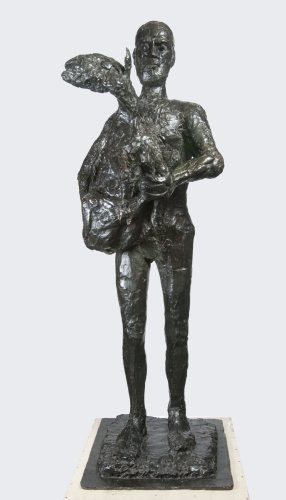
A grandson of the famous Romantic poet, William Hutchinson Wordsworth (1835-1917) served as the Principal of Elphinstone College in Bombay (Mumbai), India, in the late 19th century. "Seducing a ewe" makes one think of Picasso's sculpture Man with a Lamb (1943):
Dr. Blue brings to mind Picasso's Blue Period (1901-1904). In J. D. Salinger’s 1952 story De Daumier-Smith's Blue Period (included in “Nine Stories”) the narrator tells M. Yoshoto that Picasso was a friend of his parents:
It was a bus ride of several miles from Windsor Station to the school. I doubt if M. Yoshoto said five words the whole way. Either in spite, or because, of his silence, I talked incessantly, with my legs crossed, ankle on knee, and constantly using my sock as an absorber for the perspiration on my palm. It seemed urgent to me not only to reiterate my earlier lies--about my kinship with Daumier, about my deceased wife, about my small estate in the South of France--but to elaborate on them. At length, in effect to spare myself from dwelling on these painful reminiscences (and they were beginning to feel a little painful), I swung over to the subject of my parents' oldest and dearest friend: Pablo Picasso. Le pauvre Picasso, as I referred to him. (I picked Picasso, I might mention, because he seemed to me the French painter who was best-known in America. I roundly considered Canada part of America.) For M. Yoshoto's benefit, I recalled, with a showy amount of natural compassion for a fallen giant, how many times I had said to him, "M. Picasso, où allez vous?" and how, in response to this allpenetrating question, the master had never failed to walk slowly, leadenly, across his studio to look at a small reproduction of his "Les Saltimbanques" and the glory, long forfeited, that had been his. The trouble with Picasso, I explained to M. Yoshoto as we got out of the bus, was that he never listened to anybody--even his closest friends.
The action in Salinger's story takes place in Montreal. According to Humbert, he picked up Rita one May evening at a roadside bar somewhere between Montreal and New York:
She was twice Lolita’s age and three quarters of mine: a very slight, dark-haired, pale-skinned adult, weighing a hundred and five pounds, with charmingly asymmetrical eyes, and angular, rapidly sketched profile, and a most appealing ensellure to her supple back - I think she had some Spanish or Babylonian blood. I picked her up one depraved May evening somewhere between Montreal and New York, or more narrowly, between Toylestown and Blake, at a darkishly burning bar under the sign of the Tigermoth, where she was amiably drunk: she insisted we had gone to school together, and she placed her trembling little hand on my ape paw. My senses were very slightly stirred but I decided to give her a try; I did - and adopted her as a constant companion. She was so kind, was Rita, such a good sport, that I daresay she would have given herself to any pathetic creature or fallacy, an old broken tree or a bereaved porcupine, out of sheer chumminess and compassion.
When I first met her she had but recently divorced her third husband - and a little more recently had been abandoned by her seventh cavalier servant the others, the mutables, were too numerous and mobile to tabulate. Her brother was - and no doubt still is - a prominent, pasty-faced, suspenders-and-painted-tie-wearing politician, mayor and boaster of his ball-playing, Bible-reading, grain-handling home town. For the last eight years he had been paying his great little sister several hundred dollars per month under the stringent condition that she would never never enter great little Grainball City. She told me, with wails of wonder, that for some God-damn reason every new boy friend of hers would first of all take her Grainball-ward: it was a fatal attraction; and before she knew what was what, she would find herself sucked into the lunar orbit of the town, and would be following the flood-lit drive that encircled it “going round and round,” as she phrased it, “like a God-damn mulberry moth.” (2.26)