
In his Foreword and Commentary to Shade's poem Kinbote (in VN’s novel Pale Fire, 1962, Shade’s mad commentator who imagines that he is Charles the Beloved, the last self-exiled king of Zembla) mentions a distinguished Zemblan scholar Oscar Nattochdag:
Alas, my peace of mind was soon to be shattered. The thick venom of envy began squirting at me as soon as academic suburbia realized that John Shade valued my society above that of all other people. Your snicker, my dear Mrs. C., did not escape our notice as I was helping the tired old poet to find his galoshes after that dreary get-together party at your house. One day I happened to enter the English Literature office in quest of a magazine with the picture of the Royal Palace in Onhava, which I wanted my friend to see, when I overheard a young instructor in a green velvet jacket, whom I shall mercifully call Gerald Emerald, carelessly saying in answer to something the secretary had asked: "I guess Mr. Shade has already left with the Great Beaver." Of course I am quite tall, and my brown beard is of a rather rich tint and texture; the silly cognomen evidently applied to me, but was not worth noticing, and after calmly taking the magazine from a pamphlet-cluttered table, I contented myself on my way out with pulling Gerald Emerald's bow-tie loose with a deft jerk of my fingers as I passed by him. There was also the morning when Dr. Nattochdag, head of the department to which I was attached, begged me in a formal voice to be seated, then closed the door, and having regained, with a downcast frown, his swivel chair, urged me "to be more careful." In what sense, careful? A boy had complained to his adviser. Complained of what, good Lord? That I had criticized a literature course he attended ("a ridiculous survey of ridiculous works, conducted by a ridiculous mediocrity"). Laughing in sheer relief, I embraced my good Netochka, telling him I would never be naughty again. I take this opportunity to salute him. He always behaved with such exquisite courtesy toward me that I sometimes wondered if he did not suspect what Shade suspected, and what only three people (two trustees and the president of the college) definitely knew. (Foreword)
Line 627: The great Starover Blue
Presumably, permission from Prof. Blue was obtained but even so the plunging of a real person, no matter how sportive and willing, into an invented milieu where he is made to perform in accordance with the invention, strikes one as a singularly tasteless device, especially since other real-life characters, except members of the family, of course, are pseudonymized in the poem.
This name, no doubt, is most tempting. The star over the blue eminently suits an astronomer though actually neither his first nor second name bears any relation to the celestial vault: the first was given him in memory of his grandfather, a Russian starover (accented, incidentally, on the ultima), that is, Old Believer (member of a schismatic sect), named Sinyavin, from siniy, Russ. "blue." This Sinyavin migrated from Saratov to Seattle and begot a son who eventually changed his name to Blue and married Stella Lazurchik, an Americanized Kashube. So it goes. Honest Starover Blue will probably be surprised by the epithet bestowed upon him by a jesting Shade. The writer feels moved to pay here a small tribute to the amiable old freak, adored by everybody on the campus and nicknamed by the students Colonel Starbottle, evidently because of his exceptionally convivial habits. After all, there were other great men in our poet's entourage - for example, that distinguished Zemblan scholar Oscar Nattochdag.
Pictures of the King had not infrequently appeared in America during the first months of the Zemblan Revolution. Every now and then some busybody on the campus with a retentive memory, or one of the clubwomen who were always after Shade and his eccentric friend, used to ask me with the inane meaningfulness adopted in such cases if anybody had told me how much I resembled that unfortunate monarch. I would counter with something on the lines of "all Chinese look alike" and change the subject. One day, however, in the lounge of the Faculty Club where I lolled surrounded by a number of my colleagues, I had to put up with a particularly embarrassing onset. A visiting German lecturer from Oxford kept exclaiming, aloud and under his breath, that the resemblance was "absolutely unheard of," and when I negligently observed that all bearded Zemblans resembled one another - and that, in fact, the name Zembla is a corruption not of the Russian zemlya, but of Semblerland, a land of reflections, of "resemblers" - my tormentor said: "Ah, yes, but King Charles wore no beard, and yet it is his very face! I had [he added] the honor of being seated within a few yards of the royal box at a Sport Festival in Onhava which I visited with my wife, who is Swedish, in 1956. We have a photograph of him at home, and her sister knew very well the mother of one of his pages, an interesting woman. Don't you see [almost tugging at Shade's lapel] the astounding similarity of features - of the upper part of the face, and the eyes, yes, the eyes, and the nose bridge?"
"Nay, sir" [said Shade, refolding a leg and slightly rolling in his armchair as wont to do when about to deliver a pronouncement] "there is no resemblance at all. I have seen the King in newsreels, and there is no resemblance. Resemblances are the shadows of differences. Different people see different similarities and similar differences."
Good Netochka, who had been looking singularly uncomfortable during this exchange, remarked in his gentle voice how sad it was to think that such a "sympathetic ruler" had probably perished in prison.
A professor of physics now joined in. He was a so-called Pink, who believed in what so-called Pinks believe in (Progressive Education, the Integrity of anyone spying for Russia, Fall-outs occasioned solely by US-made bombs, the existence in the near past of a McCarthy Era, Soviet achievements including Dr. Zhivago, and so forth): "Your regrets are groundless" [said he]. "That sorry ruler is known to have escaped disguised as a nun; but whatever happens, or has happened to him, cannot interest the Zemblan people. History has denounced him, and that is his epitaph."
Shade: "True, sir. In due time history will have denounced everybody. The King may be dead, or he may be as much alive as you and Kinbote, but let us respect facts. I have it from him [pointing to me] that the widely circulated stuff about the nun is a vulgar pro-Extremist fabrication. The Extremists and their friends invented a lot of nonsense to conceal their discomfiture; but the truth is that the King walked out of the palace, and crossed the mountains, and left the country, not in the black garb of a pale spinster but dressed as an athlete in scarlet wool."
"Strange, strange," said the German visitor, who by some quirk of alderwood ancestry had been alone to catch the eerie note that had throbbed by and was gone.
Shade [smiling and massaging my knee]: "Kings do not die--they only disappear, eh, Charles?"
"Who said that?" asked sharply, as if coming out of a trance, the ignorant, and always suspicious, Head of the English Department.
"Take my own case," continued my dear friend ignoring Mr. H. "I have been said to resemble at least four people: Samuel Johnson; the lovingly reconstructed ancestor of man in the Exton Museum; and two local characters, one being the slapdash disheveled hag who ladles out the mash in the Levin Hall cafeteria."
"The third in the witch row," I precised quaintly, and everybody laughed.
"I would rather say," remarked Mr. Pardon--American History--"that she looks like Judge Goldsworth" ("One of us," interposed Shade inclining his head), "especially when he is real mad at the whole world after a good dinner."
"I heard," hastily began Netochka, "that the Goldsworths are having a wonderful time--"
"What a pity I cannot prove my point," muttered the tenacious German visitor. "If only there was a picture here. Couldn't there be somewhere--"
"Sure," said young Emerald and left his seat.
Professor Pardon now spoke to me: "I was under the impression that you were born in Russia, and that your name was a kind of anagram of Botkin or Botkine?"
Kinbote: "You are confusing me with some refugee from Nova Zembla [sarcastically stressing the "Nova"].
"Didn't you tell me, Charles, that kinbote means regicide in your language?" asked my dear Shade.
"Yes, a king's destroyer," I said (longing to explain that a king who sinks his identity in the mirror of exile is in a sense just that).
Shade [addressing the German visitor]: "Professor Kinbote is the author of a remarkable book on surnames. I believe [to me] there exists an English translation?"
"Oxford, 1956," I replied.
"You do know Russian, though?" said Pardon. "I think I heard you, the other day, talking to--what's his name--oh, my goodness" [laboriously composing his lips].
Shade: "Sir, we all find it difficult to attack that name" [laughing].
Professor Hurley: "Think of the French word for 'tire': punoo."
Shade: "Why, sir, I am afraid you have only punctured the difficulty" [laughing uproariously].
"Flatman," quipped I. "Yes," I went on, turning to Pardon, "I certainly do speak Russian. You see, it was the fashionable language par excellence, much more so than French, among the nobles of Zembla at least, and at its court. Today, of course, all this has changed. It is now the lower classes who are forcibly taught to speak Russian."
"Aren't we, too trying to teach Russian in our schools?" said Pink.
In the meantime, at the other end of the room, young Emerald had been communing with the bookshelves. At this point he returned with the the T-Z volume of an illustrated encyclopedia.
"Well," said he, "here he is, that king. But look, he is young and handsome" ("Oh, that won't do," wailed the German visitor.) "Young, handsome, and wearing a fancy uniform," continued Emerald. "Quite the fancy pansy, in fact."
"And you," I said quietly, "are a foul-minded pup in a cheap green jacket."
"But what have I said?" the young instructor inquired of the company, spreading out his palms like a disciple in Leonardo's Last Supper.
"Now, now," said Shade. "I'm sure, Charles, our young friend never intended to insult your sovereign and namesake."
"He could not, even if he had wished," I observed placidly, turning it all into a joke.
Gerald Emerald extended his hand--which at the moment of writing still remains in that position. (note to Line 894)
Natt och dag means in Swedish "night and day." Belye nochi ("The White Nights," 1848) and Netochka Nezvanov (1849) are novels by Dostoevski. In Oscar Wilde's poem The Ballad of the Readig Gaol (1898) the phrase "night and day" occurs three times. On the other hand, Oscar Nattochdag (good old Netochka) and Starover Blue bring to mind L'Empire des lumières (The Empire of Light), a succession of 27 paintings by René Magritte (a Belgian surrealist artist, 1898-1967). They depict the paradoxical image of a nocturnal landscape beneath a sunlit sky. Magritte's Empire of Light reminds one of empires of rhyme mentioned by Shade in Canto Three of his poem:
But who can teach the thoughts we should roll-call
When morning finds us marching to the wall
Under the stage direction of some goon
Political, some uniformed baboon?
We'll think of matters only known to us -
Empires of rhyme, Indies of calculus;
Listen to distant cocks crow, and discern
Upon the rough gray wall a rare wall fern;
And while our royal hands are being tied,
Taunt our inferiors, cheerfully deride
The dedicated imbeciles, and spit
Into their eyes just for the fun of it. (ll. 597-608)
"Indies of calculus" make one think of the Golconda in Kinbote's cuff links:
Imagine a soft, clumsy giant; imagine a historical personage whose knowledge of money is limited to the abstract billions of a national debt; imagine an exiled prince who is unaware of the Golconda in his cuff links! This is to say - oh, hyperbolically - that I am the most impractical fellow in the world. Between such a person and an old fox in the book publishing business, relations are at first touchingly carefree and chummy, with expansive banterings and all sorts of amiable tokens. I have no reason to suppose that anything will ever happen to prevent this initial relationship with good old Frank, my present publisher, from remaining a permanent fixture. (Foreword)
Golconda (1953) is a painting by Magritte:
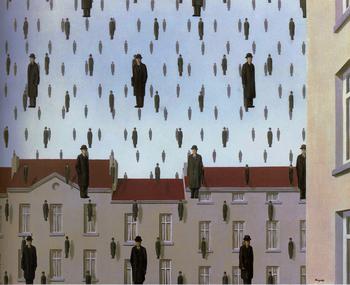
Magritte's raining men are somehow suggestive of Gradus (Shade's murderer) and his loosely folded umbrella:
Lines 131-132: I was the shadow of the waxwing slain by feigned remoteness in the windowpane.
The exquisite melody of the two lines opening the poem is picked up here. The repetition of that long-drawn note is saved from monotony by the subtle variation in line 132 where the assonance between its second word and the rhyme gives the ear a kind of languorous pleasure as would the echo of some half-remembered sorrowful song whose strain is more meaningful than its words. Today, where the "feigned remoteness" has indeed performed its dreadful duty, and the poem we have is the only "shadow" that remains, we cannot help reading into these lines something more than mirrorplay and mirage shimmer. We feel doom, in the image of Gradus, eating away the miles and miles of "feigned remoteness" between him and poor Shade. He, too, is to meet, in his urgent and blind flight, a reflection that will shatter him.
Although Gradus availed himself of all varieties of locomotion - rented cars, local trains, escalators, airplanes - somehow the eye of the mind sees him, and the muscles of the mind feel him, as always streaking across the sky with black traveling bag in one hand and loosely folded umbrella in the other, in a sustained glide high over sea and land. The force propelling him is the magic action of Shade's poem itself, the very mechanism and sweep of verse, the powerful iambic motor. Never before has the inexorable advance of fate received such a sensuous form (for other images of that transcendental tramp's approach see note to line 17).