
Describing his first physical contact with Lolita, Humbert Humbert (the narrator and main character in VN’s novel Lolita, 1955) mentions the picture in Lolita's magazine: a surrealist painter relaxing, supine, on a beach, and near him, likewise supine, a plaster replica of the Venus di Milo, half-buried in sand:
I want my learned readers to participate in the scene I am about to replay; I want them to examine its every detail and see for themselves how careful, how chaste, the whole wine-sweet event is if viewed with what my lawyer has called, in a private talk we have had, “impartial sympathy.” So let us get started. I have a difficult job before me.
Main character: Humbert the Hummer. Time: Sunday morning in June. Place: sunlit living room. Props: old, candy-striped davenport, magazines, phonograph, Mexican knickknacks (the late Mr. Harold E. Haze - God bless the good man - had engendered my darling at the siesta hour in a blue-washed room, on a honeymoon trip to Vera Cruz, and mementoes, among these Dolores, were all over the place). She wore that day a pretty print dress that I had seen on her once before, ample in the skirt, tight in the bodice, short-sleeved, pink, checkered with darker pink, and, to complete the color scheme, she had painted her lips and was holding in her hollowed hands a beautiful, banal, Eden-red apple. She was not shod, however, for church. And her white Sunday purse lay discarded near the phonograph.
My heart beat like a drum as she sat down, cool skirt ballooning, subsiding, on the sofa next to me, and played with her glossy fruit. She tossed it up into the sun-dusted air, and caught it - it made a cupped polished plop.
Humbert Humbert intercepted the apple.
“Give it back,”—she pleaded, showing the marbled flush of her palms. I produced Delicious. She grasped it and bit into it, and my heart was like snow under thin crimson skin, and with the monkeyish nimbleness that was so typical of that American nymphet, she snatched out of my abstract grip the magazine I had opened (pity no film had recorded the curious pattern, the monogrammic linkage of our simultaneous or overlapping moves). Rapidly, hardly hampered by the disfigured apple she held, Lo flipped violently through the pages in search of something she wished Humbert to see. Found it at last. I faked interest by bringing my head so close that her hair touched my temple and her arm brushed my cheek as she wiped her lips with her wrist. Because of the burnished mist through which I peered at the picture, I was slow in reacting to it, and her bare knees rubbed and knocked impatiently against each other. Dimly there came into view: a surrealist painter relaxing, supine, on a beach, and near him, likewise supine, a plaster replica of the Venus di Milo, half-buried in sand. Picture of the Week, said the legend. I whisked the whole obscene thing away. Next moment, in a sham effort to retrieve it, she was all over me. Caught her by her thin knobby wrist. The magazine escaped to the floor like a flustered fowl. She twisted herself free, recoiled, and lay back in the right-hand corner of the davenport. Then, with perfect simplicity, the impudent child extended her legs across my lap. (1.13)
Venus de Milo with Drawers (1936) is a sculpture by Salvador Dali (a Spanish surrealist artist, 1904-1989):

Humbert keeps his intimate pocket diary in the locked up drawer of a little table of imitation mahogany:
So Charlotte sauntered in. She felt all was not well between us. I had pretended to fall asleep the night before, and the night before that, as soon as we had gone to bed, and had risen at dawn.
Tenderly, she inquired if she were not “interrupting.”
“Not at the moment,” I said, turning volume C of the Girls’ Encyclopedia around to examine a picture printed “bottom-edge” as printers say.
Charlotte went up to a little table of imitation mahogany with a drawer. She put her hand upon it. The little table was ugly, no doubt, but it had done nothing to her.
“I have always wanted to ask you,” she said (businesslike, not coquettish), “why is this thing locked up? Do you want it in this room? It’s so abominably uncouth.”
“Leave it alone,” I said. I was Camping in Scandinavia.
“Is there a key?”
“Hidden.”
“Oh, Hum…”
“Locked up love letters.”
She gave me one of those wounded-doe looks that irritated me so much, and then, not quite knowing if I was serious, or how to keep up the conversation, stood for several slow pages (Campus, Canada, Candid Camera, Candy) peering at the window pane rather than through it, drumming upon it with sharp almond-and-rose fingernails.
Presently (at Canoeing or Canvasback) she strolled up to my chair and sank down, tweedily, weightily, on its arm, inundating me with the perfume my first wife had used. “Would his lordship like to spend the fall here?” she asked, pointing with her little finger at an autumn view in a conservative Eastern State. “Why?” (very distinctly and slowly). She shrugged. (Probably Harold used to take a vacation at that time. Open season. Conditional reflex on her part.)
“I think I know where that is,” she said, still pointing. “There is a hotel I remember, Enchanted Hunters, quaint, isn’t it? And the food is a dream. And nobody bothers anybody.”
She rubbed her cheek against my temple. Valeria soon got over that.
“Is there anything special you would like for dinner, dear? John and Jean will drop in later.”
I answered with a grunt. She kissed me on my underlip, and, brightly saying she would bake a cake (a tradition subsisted from my lodging days that I adored her cakes), left me to my idleness.
Carefully putting down the open book where she had sat (it attempted to send forth a rotation of waves, but an inserted pencil stopped the pages), I checked the hiding place of the key: rather self-consciously it lay under the old expensive safety razor I had used before she bought me a much better and cheaper one. Was it the perfect hiding place - there, under the razor, in the groove of its velvet-lined case? The case lay in a small trunk where I kept various business papers. Could I improve upon this? Remarkable how difficult it is to conceal things - especially when one’s wife keeps monkeying with the furniture. (1.21)
Lolita's mother Charlotte perishes under the wheels of a truck because of Junk's hysterical setter after she managed to open the drawer and read Humbert's diary:
The day before I had ended the regime of aloofness I had imposed upon myself, and now uttered a cheerful homecoming call as I opened the door of the living room. With her cream-white nape and bronze bun to me, wearing the yellow blouse and maroon slacks she had on when I first met her, Charlotte sat at the corner bureau writing a letter. My hand still on the doorknob, I repeated my hearty cry. Her writing hand stopped. She sat still for a moment; then she slowly turned in her chair and rested her elbow on its curved back. Her face, disfigured by her emotion, was not a pretty sight as she stared at my legs and said:
“The Haze woman, the big bitch, the old cat, the obnoxious mamma, the - the old stupid Haze is no longer your dupe. She has - she has…”
My fair accuser stopped, swallowing her venom and her tears. Whatever Humbert Humbert saidor attempted to sayis inessential. She went on:
“You’re a monster. You’re a detestable, abominable, criminal fraud. If you come nearI’ll scream out the window. Get back!”
Again, whatever H. H. murmured may be omitted, I think.
“I am leaving tonight. This is all yours. Only you’ll never, never see that miserable brat again. Get out of this room.”
Reader, I did. I went up to the ex-semi-studio. Arms akimbo, I stood for a moment quite still and self-composed, surveying from the threshold the raped little table with its open drawer, a key hanging from the lock, four other household keys on the table top. I walked across the landing into the Humberts’ bedroom, and calmly removed my diary from under her pillow into my pocket. Then I started to walk downstairs, but stopped half-way: she was talking on the telephone which happened to be plugged just outside the door of the living room. I wanted to hear what she was saying: she canceled an order for something or other, and returned to the parlor. I rearranged my respiration and went through the hallway to the kitchen. There, I opened a bottle of Scotch. She could never resist Scotch. Then I walked into the dining room and from there, through the half-open door, contemplated Charlotte’s broad back.
“You are ruining my life and yours,” I said quietly. “Let us be civilized people. It is all your hallucination. You are crazy, Charlotte. The notes you found were fragments of a novel. Your name and hers were put in by mere chance. Just because they came handy. Think it over. I shall bring you a drink.”
She neither answered nor turned, but went on writing in a scorching scrawl whatever she was writing. A third letter, presumably (two in stamped envelopes were already laid out on the desk). I went back to the kitchen.
I set out two glasses (to St. Algebra? to Lo?) and opened the refrigerator. It roared at me viciously while I removed the ice from its heart. Rewrite. Let her read it again. She will not recall details. Change, forge. Write a fragment and show it to her or leave it lying around. Why do faucets sometimes whine so horribly? A horrible situation, really. The little pillow-shaped blocks of icepillows for polar teddy bear, Lo - emitted rasping, crackling, tortured sounds as the warm water loosened them in their cells. I bumped down the glasses side by side. I poured in the whiskey and a dram of soda. She had tabooed my pin. Bark and bang went the icebox. Carrying the glasses, I walked through the dining room and spoke through the parlor door which was a fraction ajar, not quite space enough for my elbow.
“I have made you a drink,” I said.
She did not answer, the mad bitch, and I placed the glasses on the sideboard near the telephone, which had started to ring.
“Leslie speaking. Leslie Tomson,” said Leslie Tomson who favored a dip at dawn. “Mrs. Humbert, sir, has been run over and you’d better come quick.”
I answered, perhaps a bit testily, that my wife was safe and sound, and still holding the receiver, I pushed open the door and said:
“There’s this man saying you’ve been killed, Charlotte.”
But there was no Charlotte in the living room. (1.22)
An amateur artist, Jean Farlow asks Humbert if he ever tried painting:
From the debouchment of the trail came a rustle, a footfall, and Jean Farlow marched down with her easel and things.
“You scared us,” said Charlotte.
Jean said she had been up there, in a place of green concealment, spying on nature (spies are generally shot), trying to finish a lakescape, but it was no good, she had no talent whatever (which was quite true) - ”And have you ever tried painting, Humbert?” Charlotte, who was a little jealous of Jean, wanted to know if John was coming.
He was. He was coming home for lunch today. He had dropped her on the way to Parkington and should be picking her up any time now. It was a grand morning. She always felt a traitor to Cavall and Melampus for leaving them roped on such gorgeous days. She sat down on the white sand between Charlotte and me. She wore shorts. Her long brown legs were about as attractive to me as those of a chestnut mare. She showed her gums when she smiled.
“I almost put both of you into my lake,” she said. “I even noticed something you overlooked. You [addressing Humbert] had your wrist watch on in, yes, sir, you had.”
“Waterproof,” said Charlotte softly, making a fish mouth.
Jean took my wrist upon her knee and examined Charlotte’s gift, then put back Humbert’s hand on the sand, palm up.
“You could see anything that way,” remarked Charlotte coquettishly.
Jean sighed. “I once saw,” she said, “two children, male and female, at sunset, right here, making love. Their shadows were giants. And I told you about Mr. Tomson at daybreak. Next time I expect to see fat old Ivor in the ivory. He is really a freak, that man. Last time he told me a completely indecent story about his nephew. It appears - ”
“Hullo there,” said John’s voice. (1.20)
Describing the Farlows, Humbert calls Lolita "my Dolita:"
A Midwesterner, as her late husband had also been, she had lived in coy Ramsdale, the gem of an eastern state, not long enough to know all the nice people. She knew slightly the jovial dentist who lived in a kind of ramshackle wooden chateau behind our lawn. She had met at a church tea the “snooty” wife of the local junk dealer who owned the “colonial” white horror at the corner of the avenue. Now and then she “visited with” old Miss Opposite; but the more patrician matrons among those she called upon, or met at lawn functions, or had telephone chats with - such dainty ladies as Mrs. Glave, Mrs. Sheridan, Mrs. McCrystal, Mrs. Knight and others, seldom seemed to call on my neglected Charlotte. Indeed, the only couple with whom she had relations of real cordiality, devoid of any arrire-pense or practical foresight, were the Farlows who had just come back from a business trip to Chile in time to attend our wedding, with the Chatfields, McCoos, and a few others (but not Mrs. Junk or the even prouder Mrs. Talbot). John Farlow was a middle-aged, quiet, quietly athletic, quietly successful dealer in sporting goods, who had an office at Parkington, forty miles away: it was he who got me the cartridges for that Colt and showed me how to use it, during a walk in the woods one Sunday; he was also what he called with a smile a part-time lawyer and had handled some of Charlotte’s affairs. Jean, his youngish wife (and first cousin), was a long-limbed girl in harlequin glasses with two boxer dogs, two pointed breasts and a big red mouth. She painted landscapes and portraits - and vividly do I remember praising, over cocktails, the picture she had made of a niece of hers, little Rosaline Honeck, a rosy honey in a Girl Scout uniform, beret of green worsted, belt of green webbing, charming shoulder-long curls - and John removed his pipe and said it was a pity Dolly (my Dolita) and Rosaline were so critical of each other at school, but he hoped, and we all hoped, they would get on better when they returned from their respective camps. We talked of the school. It had its drawbacks, and it had its virtues. “Of course, too many of the tradespeople here are Italians,” said John, “but on the other hand we are still spared” “I wish,” interrupted Jean with a laugh, “Dolly and Rosaline were spending the summer together.” Suddenly I imagined Lo returning from camp - brown, warm, drowsy, drugged - and was ready to weep with passion and impatience. (1.18)
Humbert's Dolita brings to mind Salvador Dali's Dulita:
Nabokov denied any debt to surrealism, but, as Jorge Luis Borges noted, no author likes to owe anything to his contemporaries. Still, it takes a bit of detective work to uncover Nabokov’s oblique engagement with surrealist ideas. Newly converted to surrealism, Dalí published “Rêverie” in the magazine Le Surréalisme au service de la révolution. There he only roughly sketched Dulita, but she returns, in a much more poetic and elaborate form, as a key character in his confessional memoir The Secret Life of Salvador Dalí. (from Delia Ungureanu's The Surreal Sources of “Lolita”: Nabokov and Dalí)
John Farlow's pipe makes one think of René Magritte's painting The Treachery of Images (1929):
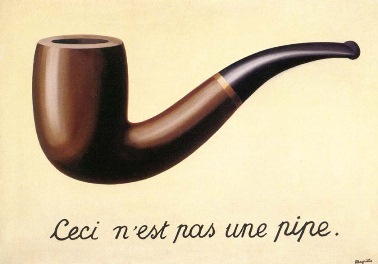
Magritte is the author of Les Menottes de Cuivre ("The Copper Handcuffs," 1931), a reimagined version of the classical sculpture, Venus de Milo:

According to Humbert Humbert, he writes "Lolita" in jail:
This daily headache in the opaque air of this tombal jail is disturbing, but I must persevere. Have written more than a hundred pages and not got anywhere yet. My calendar is getting confused. That must have been around August 15, 1947. Don’t think I can go on. Heart, head - everything. Lolita, Lolita, Lolita, Lolita, Lolita, Lolita, Lolita, Lolita, Lolita, Lolita. Repeat till the page is full, printer. (1.26)
But it seems that Humbert did not murder anybody and was never arrested. According to John Ray, Jr. (the author of the Foreword to Humbert's manuscript), Mrs. “Richard F. Schiller” (Lolita's married name) outlived Humbert Humbert (who had died in legal captivity, of coronary thrombosis, on November 16, 1952, a few days before his trial was scheduled to start) by forty days and died in childbed, giving birth to a stillborn girl, on Christmas Day 1952, in Gray Star, a settlement in the remotest Northwest:
For the benefit of old-fashioned readers who wish to follow the destinies of the “real” people beyond the “true” story, a few details may be given as received from Mr. “Windmuller,” of “Ramsdale,” who desires his identity suppressed so that “the long shadow of this sorry and sordid business” should not reach the community to which he is proud to belong. His daughter, “Louise,” is by now a college sophomore, “Mona Dahl” is a student in Paris. “Rita” has recently married the proprietor of a hotel in Florida. Mrs. “Richard F. Schiller” died in childbed, giving birth to a stillborn girl, on Christmas Day 1952, in Gray Star, a settlement in the remotest Northwest. “Vivian Darkbloom” has written a biography, “My Cue,” to be publshed shortly, and critics who have perused the manuscript call it her best book. The caretakers of the various cemeteries involved report that no ghosts walk.
But it seems that, actually, Lolita dies of ague on July 4, 1949, in the Elphinstone hospital. Everything what happens after her sudden death (Lolita's escape from the hospital, Humbert's affair with Rita, Lolita's marriage and pregnancy, the murder of Clare Quilty and Humbert's death in prison) was invented by John Ray, Jr. (Humbert Humbert's "real" name).